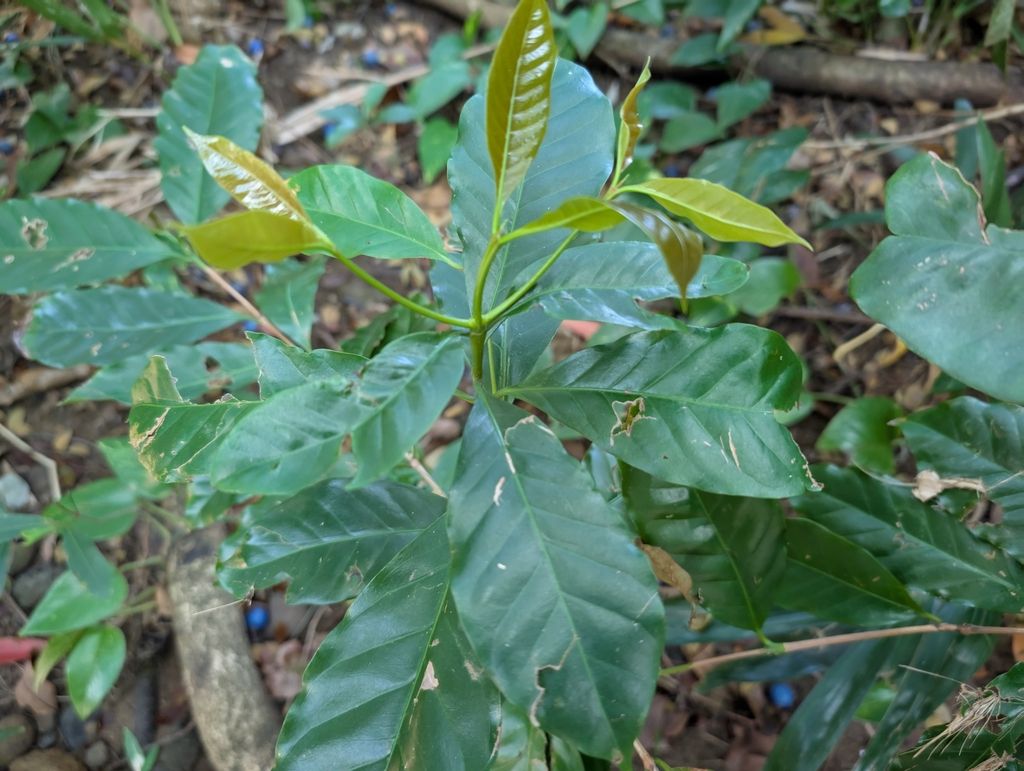
Flower profile
Coffee
Coffea arabica
Coffee (Coffea arabica) is a shrub or small tree in the Rubiaceae family.
Coffee is a flowering plant.
*iNaturalist research-grade observations, as of October 17, 2026.
On our lists for: Hawaii
Quick look
Coffea arabica, also known as the Arabica coffee, is a species of flowering plant in the coffee and madder family Rubiaceae. It is believed to be the first species of coffee to have been cultivated and is the dominant cultivar, representing about 60% of global production. Coffee produced from the less acidic, more bitter, and more highly caffeinated robusta bean makes up most of the remaining coffee production.
- It belongs to the Rubiaceae family. iNaturalist
- USDA PLANTS describes it as a shrub / a tree with a perennial life cycle. USDA PLANTS
- NatureServe lists it as not native to Hawaii. NatureServe
- USDA PLANTS lists its flower color as white. USDA PLANTS
- USDA PLANTS gives its bloom period as spring. USDA PLANTS
- USDA PLANTS lists a mature height of about 15 ft. USDA PLANTS
- iNaturalist has 520 research-grade sightings of it in Hawaii, ranking #92 among the 118 flowers on our Hawaii list. iNaturalist
When does it bloom?
There are only a handful of Hawaii flowering records, so this chart uses records from across the U.S.
Conservation status
- Federal (U.S. ESA)
- Not listed No U.S. Endangered Species Act listing in the USFWS ECOS database. USFWS ECOS
- NatureServe global
- GNR Not yet ranked worldwide. NatureServe
- Hawaii
- Not listed Not on Hawaii threatened and endangered plants (HAR 13-107; the state list follows the federal list), DLNR Division of Forestry and Wildlife. NatureServe: SNA, not applicable (usually because it isn't native there) in Hawaii. HAR 13-107
- Rare elsewhere
- No other U.S. state ranks it S1, S2, SH or SX.
Checked October 17, 2026. Rankings and lists can change, so follow the links for the latest.
Can you eat it?
NC State Extension notes: “Fruits are edible, but seeds are what are usually dried, roasted and ground to make coffee. Coffee, of course, contains caffeine.” NC State Extension
It isn't on the ASPCA plant list, and NC State Extension doesn't flag it for pets.
🌿 Never eat a wild plant unless you're certain of its ID; this isn't medical advice. Worried about a person? Call Poison Control at 1-800-222-1222. Worried about a pet? Call your vet.
Where does it grow?
USDA PLANTS records coffee in 1 states.
recorded by USDA PLANTS on our state lists not recorded
See the full list of states
Hawaii.
Hawaii counties with USDA records: Hawaii, Honolulu, Kauai, Maui.
Growing conditions
USDA PLANTS gives Coffee a low shade tolerance, medium drought tolerance and high moisture use. It is rated for soil pH 4.0 to 7.5 and winter lows down to 17 °F.
- Shade tolerance
- Low
- Drought tolerance
- Medium
- Moisture use
- High
- Soil textures it is adapted to
- coarse, medium
- Soil pH range
- 4.0 to 7.5
- Minimum temperature tolerated
- 17 °F
- Frost-free days needed (minimum)
- 365
- Annual precipitation range
- 60 to 100 inches
- Minimum root depth
- 40 inches
- Salinity tolerance
- Low
- Fertility requirement
- High
- Growth rate
- Moderate
- Lifespan
- Moderate
- Active growth period
- Year Round
- Fruit or seed
- Red · Spring to Fall
- Can be propagated by
- container, seed
- Commercial availability
- Routinely Available
From the USDA PLANTS characteristics data for COAR2. USDA ratings are general guidance for the species, not a guarantee for your garden.
Names, range and relatives
Native status by region (USDA PLANTS): Hawaii: Introduced; Pacific Basin (excluding Hawaii): Introduced; Puerto Rico: Introduced; U.S. Virgin Islands: Introduced.
County records: USDA PLANTS lists it in 15 counties across 2 states; the most are in Palau (11), Hawaii (4).
More from the Rubiaceae family (18 on Bloomipedia; most observed first): Partridgeberry, Buttonbush, Azure bluet, Field madder, Largeflower Mexican clover, Buttonweed, Tiny bluet, Shiny-leaved wild coffee.
More Hawaii flowers
Sources
- USDA, NRCS. PLANTS Database, profile COAR2.
- iNaturalist, Coffea arabica: taxonomy, research-grade observation counts and “Flowering” annotations, retrieved October 17, 2026.
- Wikipedia, Coffea arabica (lead quoted under CC BY-SA 4.0).
- Hawaii: Hawaii threatened and endangered plants (HAR 13-107; the state list follows the federal list), DLNR Division of Forestry and Wildlife.
- Hawaii: Hawaii noxious weed list (HAR 4-68).
- USFWS, ECOS species database (ESA listing check), October 17, 2026.
- NatureServe Explorer, Coffea arabica (global and state ranks).
- Edibility and toxicity: NC State Extension.
- Photo: Damien Wallace via iNaturalist · CC0 · resized.