Flower profile
Elegant clarkia
Clarkia unguiculata
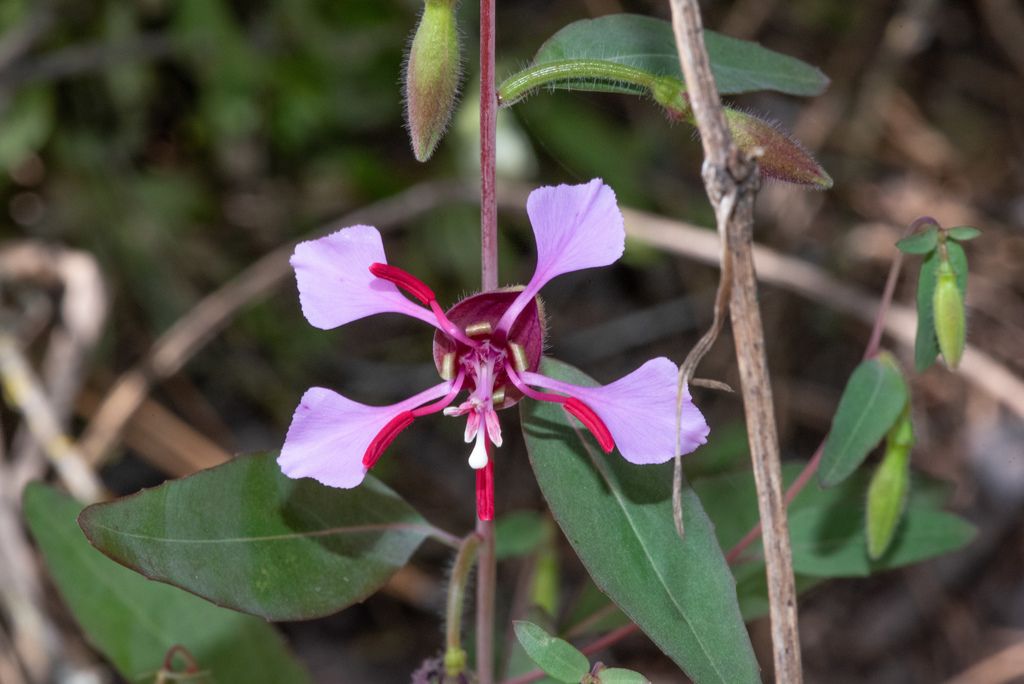
Identification
Elegant clarkia is described as herbaceous, with annual.2
The Lady Bird Johnson Wildflower Center describes plants up to about 3 feet tall.3
The Lady Bird Johnson Wildflower Center lists bloom colors as white, pink and purple.3
When it blooms
In California, most flowering sightings come in April–June.1
The Lady Bird Johnson Wildflower Center lists May–June3. iNaturalist flowering sightings across the U.S. are most often in April–June1.
Where it grows
USDA PLANTS records it in 1 state.2 It is listed as native in the lower 48 states.2 The Lady Bird Johnson Wildflower Center describes the native range as “CA Coast Ranges from Mendocino & Lake Cos., s. to n. San Diego Co.; also Sierran foothills from Butte to Kern Cos.”3 Habitat notes from the same record include dry, open or shaded slopes below 5000 ft.3
See the full state list
Growing and habitat
The Lady Bird Johnson record rates its needs as light: part shade; soil moisture: dry; soil described as “Dry soils”.3
Growing note from that record: “Do not thin seedlings as crowding encourages blooming. Able to out-compete weedy grasses.”3
Wildflower Center ratings are general guidance for the species, not a guarantee for your garden.
Related plants
Sources and review date
Facts on this page are drawn from the sources below. Numbers in the text point here. Sources used for this page were retrieved between October 17, 2026 and November 16, 2026.
- iNaturalist (taxonomy, research-grade observation counts and “Flowering” annotations, retrieved October 17, 2026).
- USDA, NRCS. PLANTS Database (profile CLUN).
- Lady Bird Johnson Wildflower Center, Native Plant Information Network (record CLUN, retrieved November 16, 2026).
- Photo: Don Loarie via iNaturalist · CC BY 4.0 · resized.