Flower profile
Flatbud prickly poppy
Argemone munita
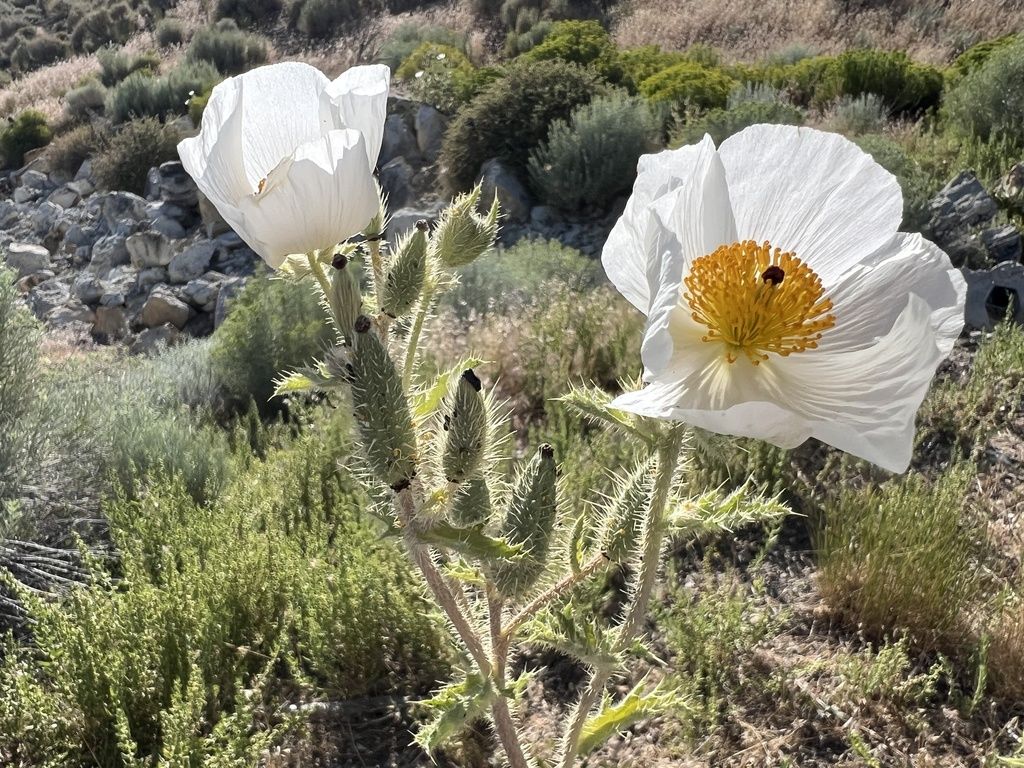
Identification
Flatbud prickly poppy is described as herbaceous, with annual, perennial.2
The Lady Bird Johnson Wildflower Center describes plants up to about 5 feet tall.3
The Lady Bird Johnson Wildflower Center lists bloom colors as white and yellow.3
When it blooms
In Nevada, most flowering sightings come in May–August.1
The Lady Bird Johnson Wildflower Center lists May–August3. iNaturalist flowering sightings across the U.S. are most often in April–August1.
Where it grows
USDA PLANTS records it in 6 states.2 It is listed as native in the lower 48 states.2 The Lady Bird Johnson Wildflower Center describes the native range as “Coast Ranges s. from San Luis Obispo Co., e. to UT.”3 Habitat notes from the same record include a variety of sites from 250-6000 ft.3
Growing and habitat
The Lady Bird Johnson record rates its needs as light: sun; soil moisture: dry; soil described as “Various drier soils”.3
Growing note from that record: “Useful only in large, rocky desert or mountain sites where little else will grow. Has the potential to be a very troublesome weed and exudes a sap which, if ingested, is poisonous to humans and range animals.”3
Wildflower Center ratings are general guidance for the species, not a guarantee for your garden.
Conservation
Other states where NatureServe ranks it rare or missing: ID (S1), OR (S2). (S1 critically imperiled, S2 imperiled, SH possibly extirpated, SX presumed extirpated.)4
Edibility and toxicity
The Lady Bird Johnson Wildflower Center warns: “Seeds and other plant parts can be toxic if ingested. Sensitivity to a toxin varies with age, weight, physical condition, and individual susceptibility. Children are most vulnerable because of their curiosity and small size. Toxicity can vary in a plant according to season,…”3
Never eat a wild plant unless you are certain of its identity; this is not medical advice. For a person, call Poison Control at 1-800-222-1222. For a pet, call your vet.
Related plants
Sources and review date
Facts on this page are drawn from the sources below. Numbers in the text point here. Sources used for this page were retrieved between October 17, 2026 and November 16, 2026.
- iNaturalist (taxonomy, research-grade observation counts and “Flowering” annotations, retrieved October 17, 2026).
- USDA, NRCS. PLANTS Database (profile ARMU).
- Lady Bird Johnson Wildflower Center, Native Plant Information Network (record ARMU, retrieved November 16, 2026).
- NatureServe Explorer (global and state ranks for Argemone munita).
- Photo: Mark Pollock via iNaturalist · CC BY 4.0 · resized.