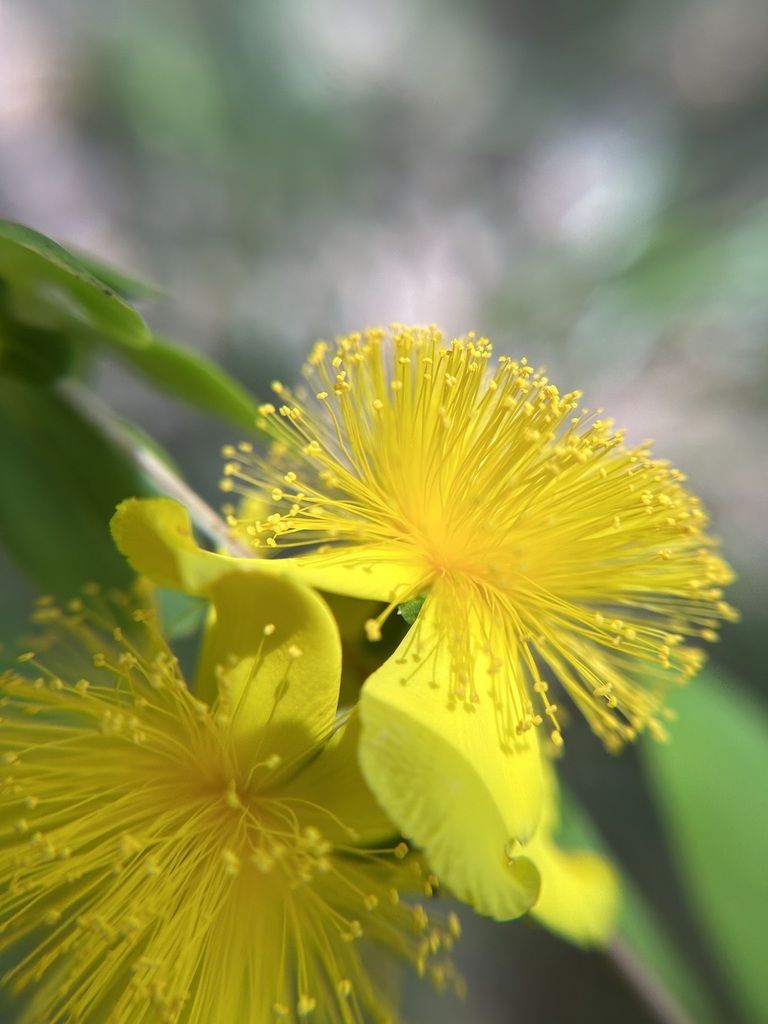
Flowering shrub
Golden St. John's wort
Hypericum frondosum
Golden St. John's wort (Hypericum frondosum) is a shrub in the Hypericaceae family, native in the lower 48 states, blooming mostly May–July across the U.S.
Golden St. John's wort is a popular flowering shrub. It's on our flower lists for 9 states, and across the U.S. it's most often seen in bloom in May–July.
*iNaturalist research-grade observations, as of October 23, 2026. Planted garden shrubs are mostly excluded from research grade.
On our lists for: Alabama, Georgia, Kentucky, Mississippi, New York, North Carolina, Pennsylvania, Tennessee, Texas
Quick look
Hypericum frondosum, the cedarglade St. Johnswort or golden St. John's wort, is a species of flowering plant in the St. John's wort family, Hypericaceae. It is native to the central and southeastern United States in dry, rocky habitats.
- It belongs to the Hypericaceae family. iNaturalist
- USDA PLANTS describes it as a shrub / a subshrub with a perennial life cycle. USDA PLANTS
- USDA PLANTS lists it as native in the lower 48 states and records it in 15 states. USDA PLANTS
- iNaturalist has 327 research-grade sightings of it in Tennessee, ranking #110 among the 182 flowers on our Tennessee list. iNaturalist
- iNaturalist has 311 research-grade sightings of it in Alabama, ranking #108 among the 167 flowers on our Alabama list. iNaturalist
- iNaturalist has 30 research-grade sightings of it in Georgia, ranking #129 among the 183 flowers on our Georgia list. iNaturalist
When does it bloom?
Bloom time in the 9 states whose Bloomipedia list includes it
| State | Type | Peak bloom | Sightings* |
|---|---|---|---|
| Tennessee | 🌷 Garden | few records (10) | 327 |
| Alabama | 🌷 Garden | few records (36) | 311 |
| Georgia | 🌷 Garden | few records (1) | 30 |
| Mississippi | 🌷 Garden | few records (6) | 11 |
| Kentucky | 🌷 Garden | no flowering records | 5 |
| North Carolina | 🌷 Garden | no flowering records | 1 |
| Texas | 🌷 Garden | no flowering records | 1 |
| New York | 🌷 Garden | no flowering records | 0 |
| Pennsylvania | 🌷 Garden | no flowering records | 0 |
Conservation status
- Federal (U.S. ESA)
- Not listed No U.S. Endangered Species Act listing in the USFWS ECOS database. USFWS ECOS
- NatureServe global
- G4 Apparently secure worldwide. NatureServe
- State rare plant lists
- Not listed Not on the official rare plant list in 7 of our 9 states.
See each state
- Tennessee
- Not listed Not on Tennessee endangered plants (Tenn. Comp. R. & Regs. 0400-06-02-.04, Rare Plant Protection and Conservation Act). NatureServe: SNR, not yet ranked in Tennessee. TN rule 0400-06-02-.04
- Georgia
- Not listed Not on Georgia protected plants (Ga. Comp. R. & Regs. 391-4-10-.09; a 2026 update is proposed). NatureServe: SNR, not yet ranked in Georgia. Ga. R. 391-4-10-.09
- Kentucky
- Not listed Not on Kentucky endangered and threatened plant lists (400 KAR 3:040, eff. 2026). NatureServe: S5, secure in Kentucky. 400 KAR 3:040
- North Carolina
- Not listed Not on North Carolina Protected Plant Species List (02 NCAC 48F .0301). NatureServe: SNA, not applicable (usually because it isn't native there) in North Carolina. 02 NCAC 48F .0301
- Texas
- Not listed Not on Texas endangered and threatened plants (31 Tex. Admin. Code § 69.8), as listed by Texas Parks and Wildlife. NatureServe: SNR, not yet ranked in Texas. 31 TAC 69.8
- New York
- Not listed Not on New York protected native plants (6 NYCRR § 193.3). NatureServe: SNR, not yet ranked in New York. 6 NYCRR § 193.3
- Pennsylvania
- Not listed Not on Pennsylvania classified native plants (17 Pa. Code Ch. 45, Subchapter B, as amended 2023). NatureServe has no Pennsylvania rank for it. 17 Pa. Code Ch. 45
- Alabama
- No list Alabama has no state law listing endangered or threatened plants, so we show NatureServe's Alabama ranks instead. NatureServe: SNR, not yet ranked in Alabama.
- Mississippi
- No list Mississippi has no state law listing endangered or threatened plants, so we show NatureServe's Mississippi ranks instead. NatureServe: SNR, not yet ranked in Mississippi.
- Rare elsewhere
- Other states where NatureServe ranks it rare or missing: IN (SX). (S1 critically imperiled, S2 imperiled, SH possibly extirpated, SX presumed extirpated.)
Checked October 23, 2026. Rankings and lists can change, so follow the links for the latest.
Can you eat it?
None of the sources we checked (NC State Extension (no edibility or poison notes on its page), USDA PLANTS) say whether it's edible or poisonous for people. NC State Extension
It isn't on the ASPCA plant list, and NC State Extension doesn't flag it for pets. For context only: ASPCA lists a related species, Hypericum perforatum (“Klamath Weed”), as toxic to dogs and cats. That doesn't tell us about this species, so keep pets away to be safe. ASPCA
🌿 Never eat a wild plant unless you're certain of its ID; this isn't medical advice. Worried about a person? Call Poison Control at 1-800-222-1222. Worried about a pet? Call your vet.
Where does it grow?
USDA PLANTS records golden St. John's wort in 15 states.
recorded by USDA PLANTS on our state lists not recorded
See the full list of states
Alabama, Connecticut, Florida, Georgia, Indiana, Kentucky, Louisiana, Massachusetts, Mississippi, New York, North Carolina, South Carolina, Tennessee, Texas, Virginia.
Tennessee counties with USDA records: Bedford, Bledsoe, Cannon, Cheatham, Claiborne, Clay, Coffee, Davidson, DeKalb, Franklin, Greene, Grundy, Hardeman, Hickman, Jackson, Knox, Lawrence, Lewis, Lincoln, Macon, Marion, Marshall, Maury, Montgomery, Overton, Putnam, Rutherford, Smith, Stewart, Sullivan, Washington, White, Williamson, Wilson.
Alabama counties with USDA records: Bibb, Bullock, Clay, Colbert, DeKalb, Etowah, Franklin, Jackson, Lawrence, Madison, Marengo, Monroe, Morgan, Randolph, Talladega, Tuscaloosa, Winston.
Georgia counties with USDA records: Bibb, Crawford, Dade, DeKalb, Early.
Names, range and relatives
Other scientific names (synonyms in USDA PLANTS): Hypericum aureum, Hypericum splendens.
County records: USDA PLANTS lists it in 90 counties across 11 states; the most are in Tennessee (34), Alabama (17), Louisiana (15).
Other Hypericum on Bloomipedia (4): Common St. John's wort, St. Andrew's cross, Fourpetal St. johnswort, Roundpod St. john's-wort.
More Tennessee flowers
Sources
- USDA, NRCS. PLANTS Database, profile HYFR.
- iNaturalist, Hypericum frondosum: taxonomy, research-grade observation counts and “Flowering” annotations, retrieved October 23, 2026.
- Wikipedia, Hypericum frondosum (lead quoted under CC BY-SA 4.0).
- State rare and invasive plant lists (15):
Show all 15 state lists
- Tennessee: Tennessee endangered plants (Tenn. Comp. R. & Regs. 0400-06-02-.04, Rare Plant Protection and Conservation Act).
- Tennessee: Tennessee Pest Plant List (Tenn. Comp. R. & Regs. 0080-06-24-.02).
- Alabama: Alabama noxious weeds (Ala. Admin. Code r. 80-10-14-.04).
- Georgia: Georgia protected plants (Ga. Comp. R. & Regs. 391-4-10-.09; a 2026 update is proposed).
- Mississippi: Mississippi Noxious Weed List (2 Miss. Code R. 1-3-01-136.01).
- Kentucky: Kentucky endangered and threatened plant lists (400 KAR 3:040, eff. 2026).
- Kentucky: Kentucky noxious weeds and invasive plants on state rights-of-way (KRS 176.051; species list from the Kentucky Transportation Cabinet).
- North Carolina: North Carolina Protected Plant Species List (02 NCAC 48F .0301).
- North Carolina: North Carolina Noxious Weed List (02 NCAC 48A .1702) (the list names any non-native Lythrum; we apply it to purple loosestrife (Lythrum salicaria), which isn't native).
- Texas: Texas endangered and threatened plants (31 Tex. Admin. Code § 69.8), as listed by Texas Parks and Wildlife.
- Texas: Texas noxious and invasive plant list (4 Tex. Admin. Code § 19.300(a)).
- New York: New York protected native plants (6 NYCRR § 193.3).
- New York: New York prohibited and regulated invasive species (6 NYCRR Part 575).
- Pennsylvania: Pennsylvania classified native plants (17 Pa. Code Ch. 45, Subchapter B, as amended 2023).
- Pennsylvania: Pennsylvania Noxious Weed List (3 Pa.C.S. § 1519, PA Dept. of Agriculture) (PDA's page spells garlic mustard “Allaria petiolata”; we match it as Alliaria petiolata).
- USFWS, ECOS species database (ESA listing check), October 23, 2026.
- NatureServe Explorer, Hypericum frondosum (global and state ranks).
- Edibility and toxicity: NC State Extension; ASPCA.
- Photo: sblumen via iNaturalist · CC BY 4.0 · resized.