Flowering shrub
Greene's mountain ash
Sorbus scopulina
Identification
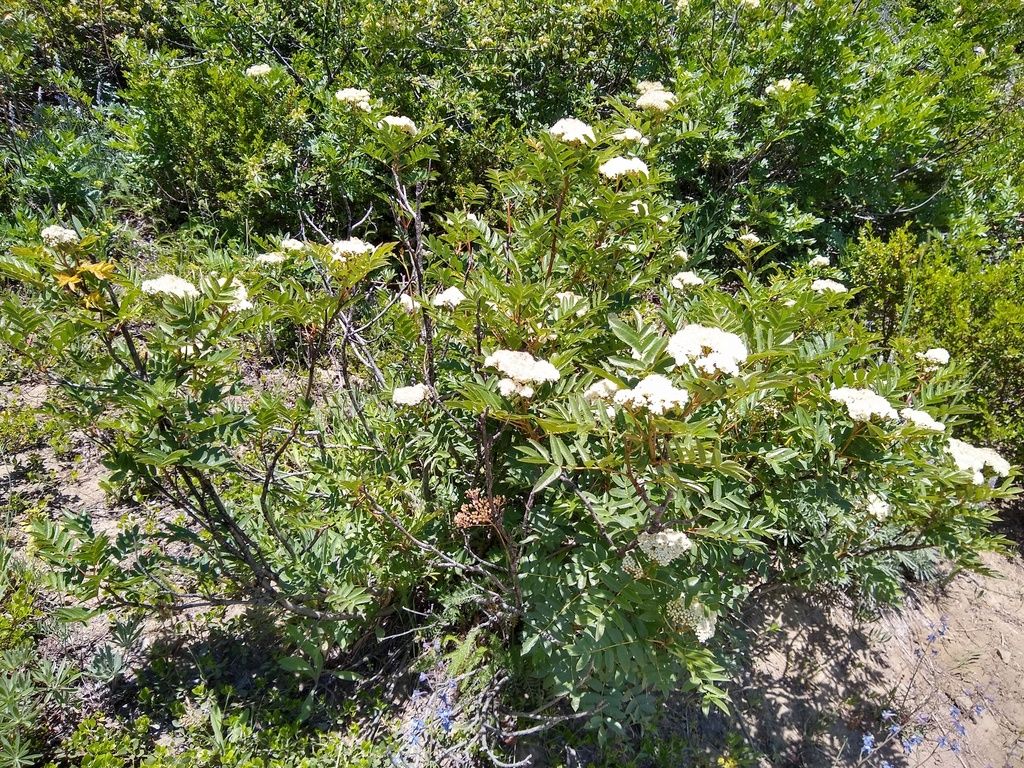
Greene's mountain ash is described as shrub, tree, with perennial, multiple stem growth form, erect habit.1
USDA PLANTS lists a mature height of about 12 ft and the Lady Bird Johnson Wildflower Center describes plants up to about 25 feet tall, often shorter. When sources disagree, the figures can reflect different plants, garden forms, or ways of measuring height.13
USDA PLANTS lists its flower color as white and bloom period as summer.1
USDA PLANTS describes green foliage, fine texture and leaves that drop in the off season.1
When it blooms
USDA PLANTS gives the bloom period as summer1. The Lady Bird Johnson Wildflower Center lists March–June3. iNaturalist flowering sightings across the U.S. are most often in June–July2.
There are only a handful of Wyoming flowering records, so this chart uses records from across the U.S.
Where it grows
USDA PLANTS records it in 14 states.1 It is listed as native in the lower 48 states.1 The Lady Bird Johnson Wildflower Center describes the native range as “W. Alt. to AK, s. to NM, UT & Tulare Co., CA; also Black Hills.”3 Habitat notes from the same record include canyons, wooded slopes, stream banks and 4000-9000 ft.3
In the garden
USDA PLANTS rates it for medium shade tolerance, none drought tolerance and medium moisture use.1 The listed soil pH range is 5.6 to 7.3, with winter lows down to -3 °F.1
The Lady Bird Johnson record rates its needs as light: sun, part shade and shade; soil moisture: moist; soil described as “Rich soils”.3
Grouse, cedar waxwings, and grosbeaks consume the berries.3
USDA PLANTS and Wildflower Center ratings are general guidance for the species, not a guarantee for your garden.
Related plants
Sources and review date
Facts on this page are drawn from the sources below. Numbers in the text point here. Sources used for this page were retrieved between October 17, 2026 and November 16, 2026.
- USDA, NRCS. PLANTS Database (profile SOSC2).
- iNaturalist (taxonomy, research-grade observation counts and “Flowering” annotations, retrieved October 17, 2026).
- Lady Bird Johnson Wildflower Center, Native Plant Information Network (record SOSC2, retrieved November 16, 2026).
- Photo: John Brew via iNaturalist · CC BY 4.0 · resized.