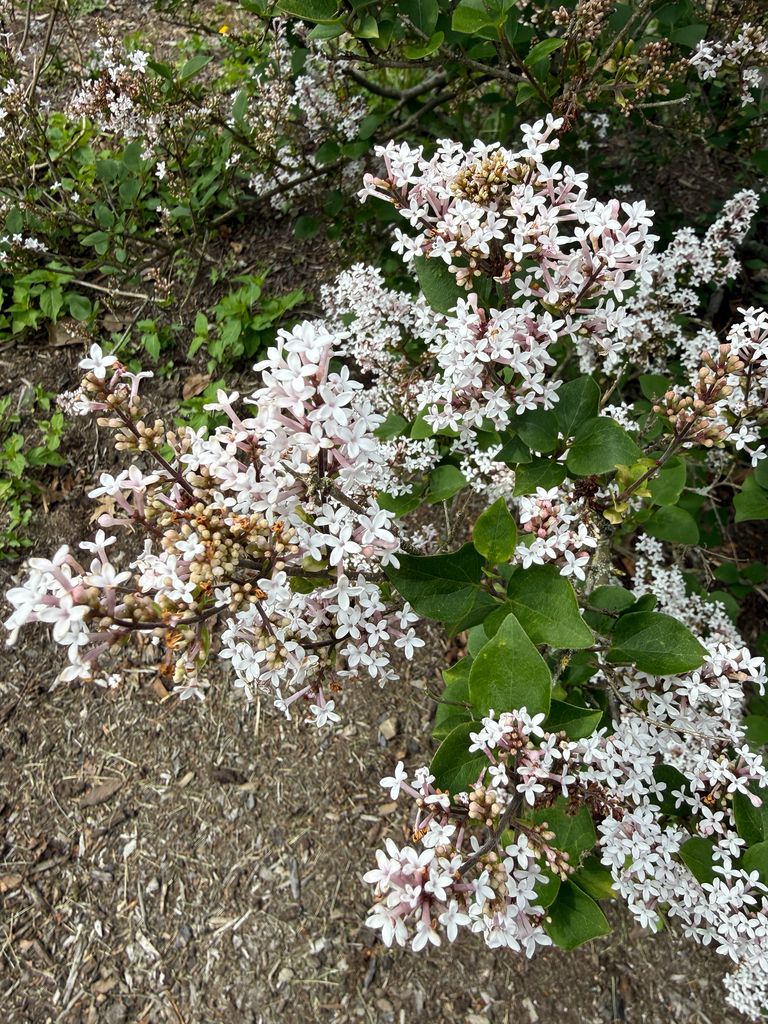
Flowering shrub
Hairy lilac
Syringa pubescens
Hairy lilac (Syringa pubescens) is a shrub in the Oleaceae family.
Hairy lilac is a popular flowering shrub. It's on our flower lists for 9 states.
*iNaturalist research-grade observations, as of October 23, 2026. Our state lists also include states where people grow it in gardens, so they can outnumber USDA's wild-plant records. Planted garden shrubs are mostly excluded from research grade.
On our lists for: Colorado, Illinois, Kentucky, Massachusetts, Minnesota, New York, Oregon, Pennsylvania, Washington
Quick look
Syringa pubescens is a species of flowering plant in the lilac genus of the family Oleaceae, native to Korea and China.
- It belongs to the Oleaceae family. iNaturalist
- iNaturalist has 1 research-grade sightings of it in Colorado, ranking #129 among the 160 flowers on our Colorado list. iNaturalist
When does it bloom?
Not enough flowering records on iNaturalist to chart yet.
Bloom time in the 9 states whose Bloomipedia list includes it
| State | Type | Peak bloom | Sightings* |
|---|---|---|---|
| Colorado | 🌷 Garden | no flowering records | 1 |
| Illinois | 🌷 Garden | no flowering records | 0 |
| Kentucky | 🌷 Garden | no flowering records | 0 |
| Massachusetts | 🌷 Garden | no flowering records | 0 |
| Minnesota | 🌷 Garden | no flowering records | 0 |
| New York | 🌷 Garden | no flowering records | 0 |
| Oregon | 🌷 Garden | no flowering records | 0 |
| Pennsylvania | 🌷 Garden | no flowering records | 0 |
| Washington | 🌷 Garden | no flowering records | 0 |
Conservation status
- Federal (U.S. ESA)
- Not listed No U.S. Endangered Species Act listing in the USFWS ECOS database. USFWS ECOS
- NatureServe
- Unknown We couldn't find this name in NatureServe Explorer. NatureServe
- State rare plant lists
- Not listed Not on the official rare plant list in 7 of our 9 states.
See each state
- Illinois
- Not listed Not on Illinois List of Endangered and Threatened Flora (17 Ill. Adm. Code 1050), per the Endangered Species Protection Board's 2025 checklist. IL E&T checklist 2025
- Kentucky
- Not listed Not on Kentucky endangered and threatened plant lists (400 KAR 3:040, eff. 2026). 400 KAR 3:040
- Massachusetts
- Not listed Not on Massachusetts Endangered Species Act list (321 CMR 10.90). MESA list
- Minnesota
- Not listed Not on Minnesota endangered, threatened and special concern plants (Minn. R. 6134.0300). Minn. R. 6134.0300
- New York
- Not listed Not on New York protected native plants (6 NYCRR § 193.3). 6 NYCRR § 193.3
- Oregon
- Not listed Not on Oregon endangered and threatened plants (OAR 603-073-0070). OAR 603-073-0070
- Pennsylvania
- Not listed Not on Pennsylvania classified native plants (17 Pa. Code Ch. 45, Subchapter B, as amended 2023). 17 Pa. Code Ch. 45
- Colorado
- No list Colorado has no state law listing endangered or threatened plants, so we show NatureServe's Colorado ranks instead.
- Washington
- No list Washington has no state law listing endangered or threatened plants (the Washington Natural Heritage Program's rare plant list isn't regulatory), so we show NatureServe's Washington ranks instead.
Checked October 23, 2026. Rankings and lists can change, so follow the links for the latest.
Can you eat it?
None of the sources we checked (NC State Extension (no page for this plant), USDA PLANTS) say whether it's edible or poisonous for people.
It isn't on the ASPCA plant list.
🌿 Never eat a wild plant unless you're certain of its ID; this isn't medical advice. Worried about a person? Call Poison Control at 1-800-222-1222. Worried about a pet? Call your vet.
Where does it grow?
USDA PLANTS has no state-by-state distribution for this name, so we can't map it yet.
Names, range and relatives
Other Syringa on Bloomipedia (3): Purple lilac, Japanese tree lilac, Meyer lilac.
More from the Oleaceae family (9 on Bloomipedia; most observed first): Downy forestiera, White fringetree, Spiny menodora, Border forsythia, Sweet olive, Chinese fringetree.
Hairy lilac and Meyer lilac are covered by the same Wikipedia article. They are listed separately because iNaturalist treats them as different taxa (Syringa pubescens and Syringa meyeri).
More Colorado flowers
Sources
- USDA, NRCS. PLANTS Database, profile SYPU2.
- iNaturalist, Syringa pubescens: taxonomy, research-grade observation counts and “Flowering” annotations, retrieved October 23, 2026.
- Wikipedia, Syringa pubescens (lead quoted under CC BY-SA 4.0).
- State rare and invasive plant lists (16):
Show all 16 state lists
- Colorado: Colorado noxious weed lists A, B and C (8 CCR 1206-2, eff. May 15, 2025).
- Illinois: Illinois List of Endangered and Threatened Flora (17 Ill. Adm. Code 1050), per the Endangered Species Protection Board's 2025 checklist.
- Illinois: Illinois Official List of Exotic Weeds (17 Ill. Adm. Code 1100.30, Illinois Exotic Weed Act).
- Kentucky: Kentucky endangered and threatened plant lists (400 KAR 3:040, eff. 2026).
- Kentucky: Kentucky noxious weeds and invasive plants on state rights-of-way (KRS 176.051; species list from the Kentucky Transportation Cabinet).
- Massachusetts: Massachusetts Endangered Species Act list (321 CMR 10.90).
- Massachusetts: Massachusetts Prohibited Plant List (MDAR) (Text from MDAR's 2023 scientific-name PDF (mass.gov blocks automated downloads); 2024-2026 additions listed on the mass.gov page: Alnus glutinosa, Pyrus calleryana, Miscanthus sinensis, Aralia elata, Rhodotypos scandens, Symplocos paniculata.).
- Minnesota: Minnesota endangered, threatened and special concern plants (Minn. R. 6134.0300).
- Minnesota: Minnesota Noxious Weed List (Minn. Stat. § 18.79; Minnesota Department of Agriculture, updated January 2026).
- New York: New York protected native plants (6 NYCRR § 193.3).
- New York: New York prohibited and regulated invasive species (6 NYCRR Part 575).
- Oregon: Oregon endangered and threatened plants (OAR 603-073-0070).
- Oregon: Oregon noxious weed quarantine, A and B weeds (OAR 603-052-1200).
- Pennsylvania: Pennsylvania classified native plants (17 Pa. Code Ch. 45, Subchapter B, as amended 2023).
- Pennsylvania: Pennsylvania Noxious Weed List (3 Pa.C.S. § 1519, PA Dept. of Agriculture) (PDA's page spells garlic mustard “Allaria petiolata”; we match it as Alliaria petiolata).
- Washington: Washington State noxious weed list (WAC 16-750-005, -011, -015).
- USFWS, ECOS species database (ESA listing check), October 23, 2026.
- Edibility and toxicity: no source found (marked "not well documented").
- Photo: nebrooks via iNaturalist · CC BY 4.0 · resized.