Flower profile
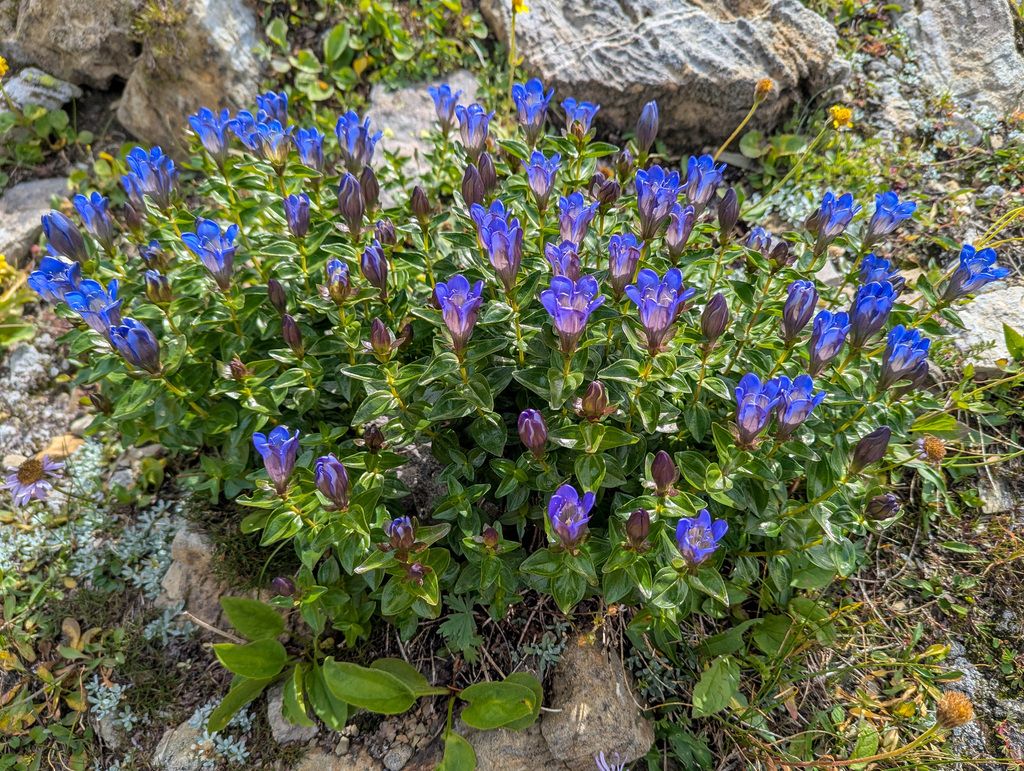
Mountain bog gentian
Gentiana calycosa
Also called Rainier pleated gentian
Identification
Mountain bog gentian is described as herbaceous, with perennial, multiple stem growth form, decumbent habit.1
USDA PLANTS lists a mature height of about 0.6 ft and the Lady Bird Johnson Wildflower Center describes plants stems decumbent , up to about 18 inches long. When sources disagree, the figures can reflect different plants, garden forms, or ways of measuring height.13
USDA PLANTS lists its flower color as blue and bloom period as late summer.1
USDA PLANTS describes green foliage, fine texture and leaves that drop in the off season.1
When it blooms
In Montana, most flowering sightings come in July–August.2
USDA PLANTS gives the bloom period as late summer1. The Lady Bird Johnson Wildflower Center lists July–October3. iNaturalist flowering sightings across the U.S. are most often in July–September2.
Where it grows
USDA PLANTS records it in 8 states.1 It is listed as native in the lower 48 states.1 The Lady Bird Johnson Wildflower Center describes the native range as “B.C. to n. CA, e. to w. MT & WY.”3 Habitat notes from the same record include moist, alpine or subalpine meadows & stream banks.3
See the full state list
Growing and habitat
USDA PLANTS rates it for low shade tolerance, none drought tolerance and medium moisture use.1 The listed soil pH range is 5.6 to 7.5, with winter lows down to 7 °F.1
The Lady Bird Johnson record rates its needs as light: part shade; soil moisture: moist; soil described as “Moist, cool soil”.3
Growing note from that record: “When using this gentian in a garden, conditions matching its wet, cold natural habitat must be met for any succuss.”3
USDA PLANTS and Wildflower Center ratings are general guidance for the species, not a guarantee for your garden.
Edibility and toxicity
The Lady Bird Johnson Wildflower Center warns: “All parts of this plant, including the nectar , are poisonous if ingested. Sensitivity to a toxin varies with age, weight, physical condition, and individual susceptibility. Children are most vulnerable because of their curiosity and small size. Toxicity can vary in a plant…”3
Never eat a wild plant unless you are certain of its identity; this is not medical advice. For a person, call Poison Control at 1-800-222-1222. For a pet, call your vet.
Related plants
Sources and review date
Facts on this page are drawn from the sources below. Numbers in the text point here. Sources used for this page were retrieved between October 17, 2026 and November 16, 2026.
- USDA, NRCS. PLANTS Database (profile GECA).
- iNaturalist (taxonomy, research-grade observation counts and “Flowering” annotations, retrieved October 17, 2026).
- Lady Bird Johnson Wildflower Center, Native Plant Information Network (record GECA, retrieved November 16, 2026).
- Photo: Tom Field via iNaturalist · CC BY 4.0 · resized.