Wild orchid
Mountain lady's-slipper
Cypripedium montanum
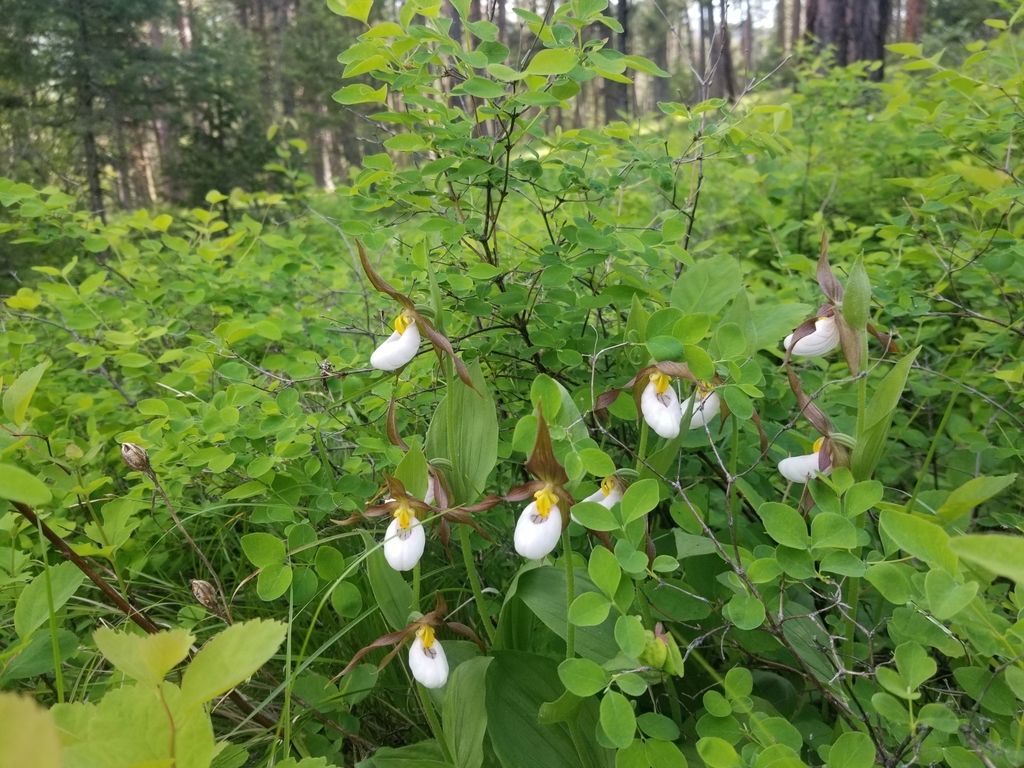
Identification
Mountain lady's-slipper is described as herbaceous, with perennial.2
The Lady Bird Johnson Wildflower Center describes plants up to about 28 inches tall.3
The Lady Bird Johnson Wildflower Center lists bloom colors as white and purple.3
When it blooms
In Montana, most flowering sightings come in June–July.1
The Lady Bird Johnson Wildflower Center lists May–July3. iNaturalist flowering sightings across the U.S. are most often in May–July1.
Where it grows
USDA PLANTS records it in 7 states.2 It is listed as native in the lower 48 states.2 The Lady Bird Johnson Wildflower Center describes the native range as “Alaska to northern California, northern Idaho, and northwestern Wyoming.”3 Habitat notes from the same record include dry or moist, open or lightly shaded, brushy or wooded valleys and slopes.3
See the full state list
Responsible viewing
If you find this plant in the wild, enjoy it where it grows. Please don't pick or dig it.
This page does not give locations for wild plants.
Conservation
Other states where NatureServe ranks it rare or missing: AK (S1), WY (S2). (S1 critically imperiled, S2 imperiled, SH possibly extirpated, SX presumed extirpated.)4
Edibility and toxicity
The Lady Bird Johnson Wildflower Center warns: “The plants of the genus Cypripedium have glandular hairs on the leaves and stems that can cause a rash, similar to poison ivy rash, upon contact.”3
Never eat a wild plant unless you are certain of its identity; this is not medical advice. For a person, call Poison Control at 1-800-222-1222. For a pet, call your vet.
Related plants
Sources and review date
Facts on this page are drawn from the sources below. Numbers in the text point here. Sources used for this page were retrieved between October 17, 2026 and November 16, 2026.
- iNaturalist (taxonomy, research-grade observation counts and “Flowering” annotations, retrieved October 17, 2026).
- USDA, NRCS. PLANTS Database (profile CYMO2).
- Lady Bird Johnson Wildflower Center, Native Plant Information Network (record CYMO2, retrieved November 16, 2026).
- NatureServe Explorer (global and state ranks for Cypripedium montanum).
- Photo: Kate via iNaturalist · CC BY 4.0 · resized.