Flowering shrub
Red bush monkeyflower
Diplacus puniceus
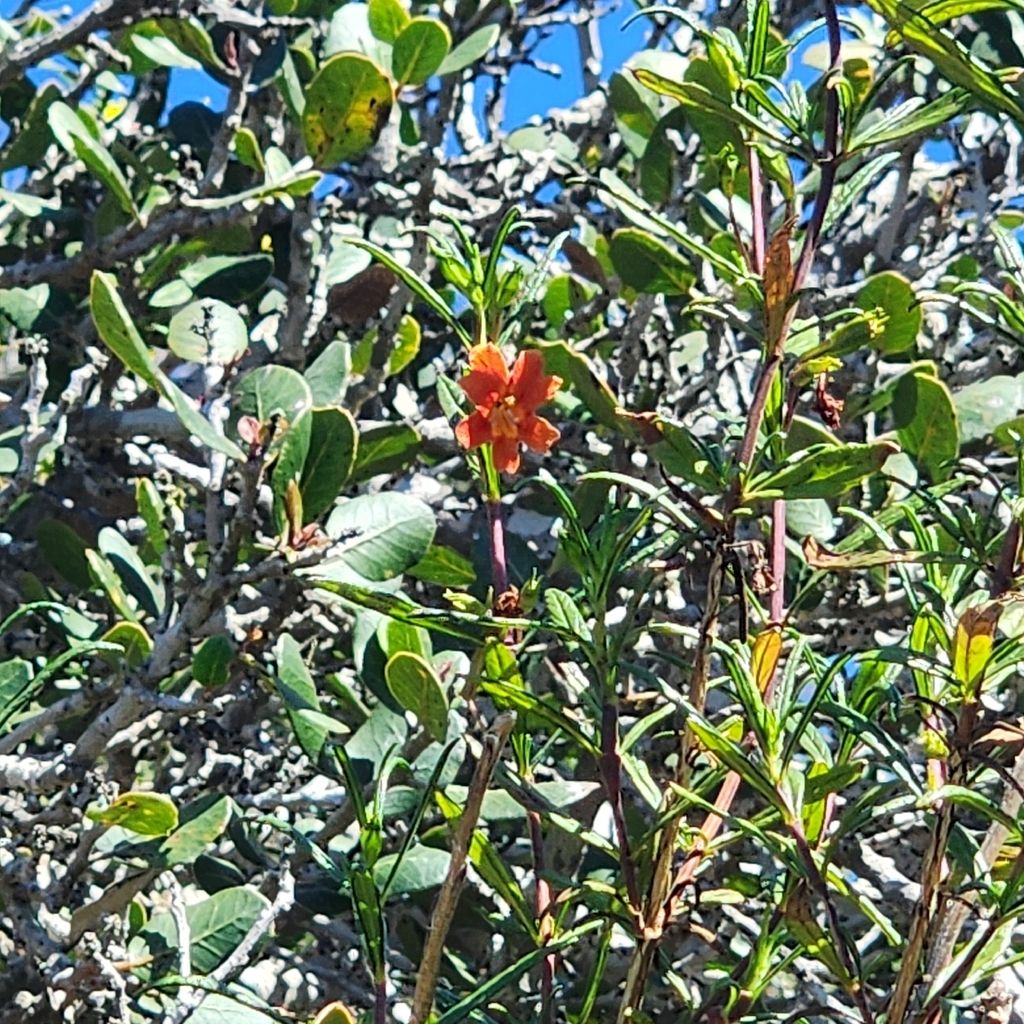
Identification
Red bush monkeyflower is described as shrub, subshrub, with perennial.2
The Lady Bird Johnson Wildflower Center describes plants up to about 6 feet tall, often shorter.3
The Lady Bird Johnson Wildflower Center lists bloom colors as red.3
When it blooms
In California, most flowering sightings come in February–April.1
The Lady Bird Johnson Wildflower Center lists March–July3. iNaturalist flowering sightings across the U.S. are most often in February–April1.
Where it grows
USDA PLANTS records it in 1 state.2 It is listed as native in the lower 48 states.2 The Lady Bird Johnson Wildflower Center describes the native range as “Laguna Beach, Santa Ana Mts. & Santa Catalina Id.; adj. Mex.”3 Habitat notes from the same record include dry slopes & mesas below 2500 ft.3
See the full state list
In the garden
The Lady Bird Johnson record rates its needs as light: part shade; soil described as “Well-drained soils”.3
Growing note from that record: “Near the coast, flowers will occur almost anytime, but peak flowering is the summer months. Plants will need reshaping as old growth becomes leggy and brittle.”3
The same record notes that it attracts hummingbirds.3
Wildflower Center ratings are general guidance for the species, not a guarantee for your garden.
Conservation
Vulnerable worldwide.4
Related plants
Sources and review date
Facts on this page are drawn from the sources below. Numbers in the text point here. Sources used for this page were retrieved between October 17, 2026 and November 16, 2026.
- iNaturalist (taxonomy, research-grade observation counts and “Flowering” annotations, retrieved October 17, 2026).
- USDA, NRCS. PLANTS Database (profile DIPU4).
- Lady Bird Johnson Wildflower Center, Native Plant Information Network (record DIPU4, retrieved November 16, 2026).
- NatureServe Explorer (global and state ranks for Diplacus puniceus).
- Photo: Dillon Alexander via iNaturalist · CC0 · resized.