Flowering shrub
Turpentine bush
Ericameria laricifolia
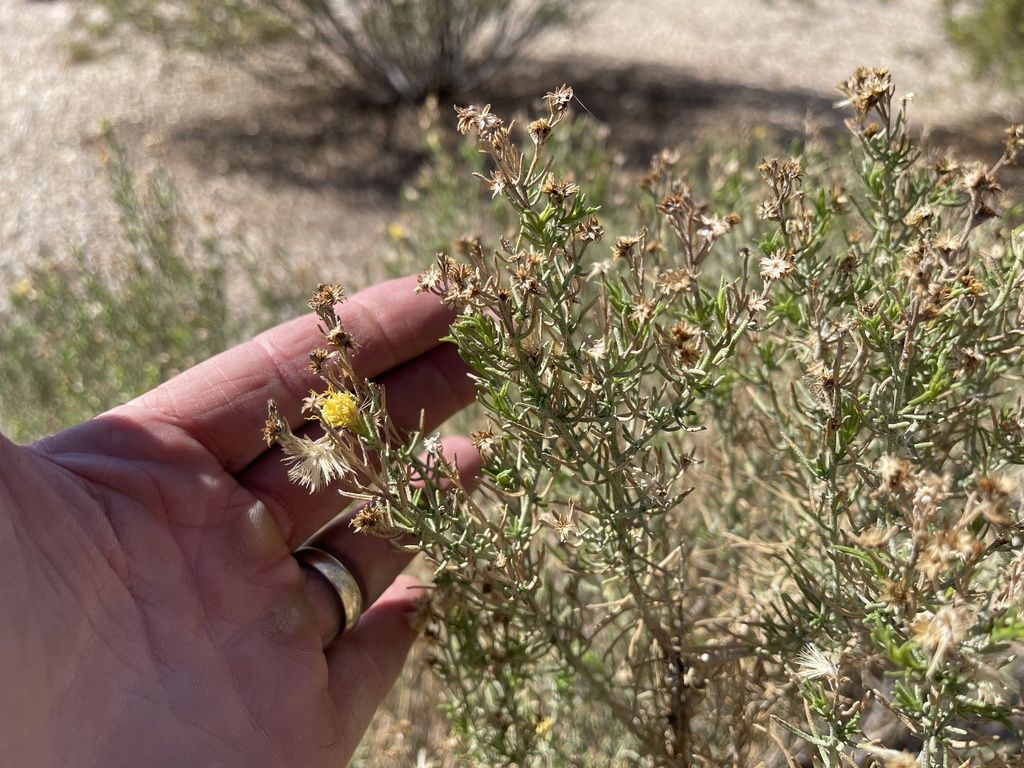
Turpentine bush is a shrub in the Asteraceae family.12 USDA PLANTS lists it as native in the lower 48 states.2 It is often found in rocky mountainous areas, mesa slopes, and canyons in the Chihuahuan, Sonoran, and eastern Mojave deserts.3 Across the U.S., flowering sightings are most often in January–December.1
Identification
Turpentine bush is described as shrub, subshrub, with perennial.2
The Lady Bird Johnson Wildflower Center describes plants normally 1 to 3 feet but can reach 6 feet.3
The Lady Bird Johnson Wildflower Center lists bloom colors as yellow.3
The Wildflower Center describes the leaves as dark olive green.3
When it blooms
In Arizona, most flowering sightings come in January–December.1
The Lady Bird Johnson Wildflower Center lists August–November3. iNaturalist flowering sightings across the U.S. are most often in January–December1.
Where it grows
USDA PLANTS records it in 6 states.2 It is listed as native in the lower 48 states.2 The Lady Bird Johnson Wildflower Center describes the native range as “West Texas, west to southeastern California, south to Chihuahua and Coahuila.”3 Habitat notes from the same record include rocky mountainous areas, mesa slopes, and canyons in the Chihuahuan, Sonoran, and eastern Mojave deserts.3
See the full state list
In the garden
The Lady Bird Johnson record rates its needs as light: sun and part shade; soil moisture: dry; soil described as “Dry, well-drained, granitic, sandy, clay loam, or limestone soils of low organic content”.3
Growing note from that record: “In areas of higher moisture than normal for this plant, may grow to 6 feet tall, but will remain narrow.”3
The same record notes that it attracts birds and butterflies.3
Wildflower Center ratings are general guidance for the species, not a guarantee for your garden.
Conservation
Other states where NatureServe ranks it rare or missing: UT (S1). (S1 critically imperiled, S2 imperiled, SH possibly extirpated, SX presumed extirpated.)4
Related plants
Sources and review date
Facts on this page are drawn from the sources below. Numbers in the text point here. Sources used for this page were retrieved between October 17, 2026 and November 16, 2026.
- iNaturalist (taxonomy, research-grade observation counts and “Flowering” annotations, retrieved October 17, 2026).
- USDA, NRCS. PLANTS Database (profile ERLA12).
- Lady Bird Johnson Wildflower Center, Native Plant Information Network (record ERLA12, retrieved November 16, 2026).
- NatureServe Explorer (global and state ranks for Ericameria laricifolia).
- Photo: CK2AZ via iNaturalist · CC BY 4.0 · resized.