Wild orchid
Downy rattlesnake plantain
Goodyera pubescens
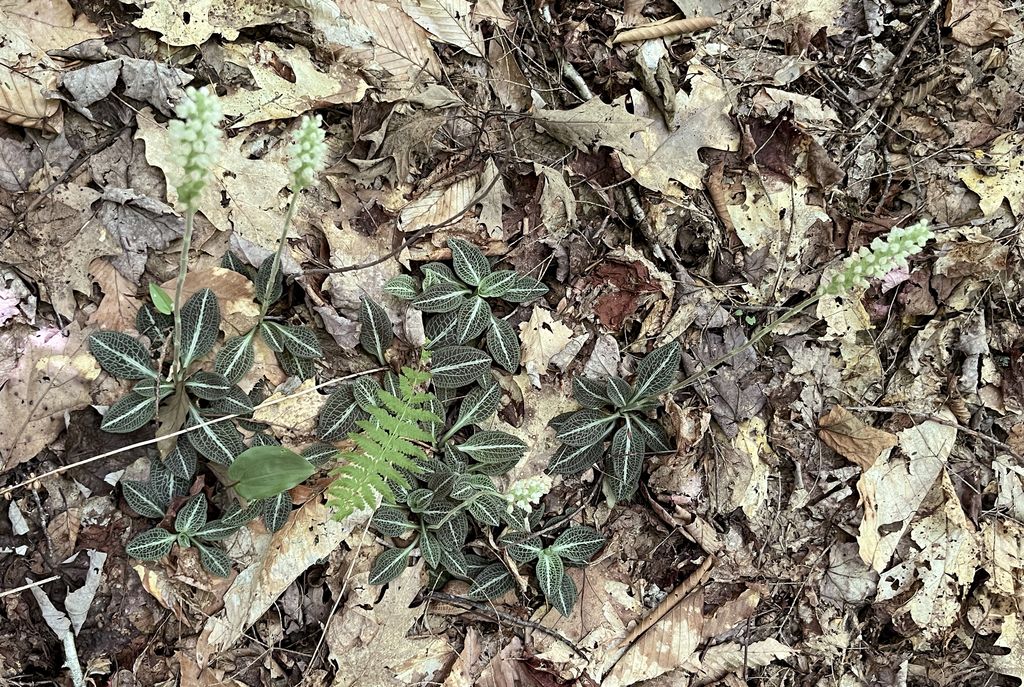
Identification
Downy rattlesnake plantain is described as herbaceous, with perennial.2
The Lady Bird Johnson Wildflower Center describes plants up to about 14 inches tall.3
The Lady Bird Johnson Wildflower Center lists bloom colors as white.3
When it blooms
The Lady Bird Johnson Wildflower Center lists May–September3. iNaturalist flowering sightings across the U.S. are most often in July–August1.
| State | Type | Peak bloom | Obs.* |
|---|---|---|---|
| Connecticut | Native | few records (32) | 861 |
| Georgia | Native | few records (38) | 1,435 |
| Kentucky | Native | July–August | 1,231 |
| Maryland | Native | few records (48) | 1,893 |
| Massachusetts | Native | July–August | 1,974 |
| North Carolina | Native | July–August | 6,355 |
See bloom time in all 12 states on our lists
| State | Type | Peak bloom | Obs.* |
|---|---|---|---|
| Connecticut | Native | few records (32) | 861 |
| Georgia | Native | few records (38) | 1,435 |
| Kentucky | Native | July–August | 1,231 |
| Maryland | Native | few records (48) | 1,893 |
| Massachusetts | Native | July–August | 1,974 |
| North Carolina | Native | July–August | 6,355 |
| Ohio | Native | July–August | 1,865 |
| Rhode Island | Native | few records (9) | 195 |
| South Carolina | Native | few records (46) | 583 |
| Tennessee | Native | July–August | 2,855 |
| Virginia | Native | July–August | 4,492 |
| West Virginia | Native | July–August | 1,271 |
*iNaturalist research-grade observations, as of October 17, 2026.1
Where it grows
USDA PLANTS records it in 31 states, plus Washington, D.C.2 It is listed as native in the lower 48 states.2 The Lady Bird Johnson Wildflower Center describes the native range as “Ontario east to New Brunswick, south to Florida, west to Louisiana and Oklahoma, and north through Missouri to Minnesota.”3 Habitat notes from the same record include dry or moist, deciduous or coniferous woods and well-drained wooded slopes.3
See the full state list
Responsible viewing
If you find this plant in the wild, enjoy it where it grows. Please don't pick or dig it.
This page does not give locations for wild plants.
Conservation
Other states where NatureServe ranks it rare or missing: FL (S1), MS (S1). (S1 critically imperiled, S2 imperiled, SH possibly extirpated, SX presumed extirpated.)4
Related plants
Sources and review date
Facts on this page are drawn from the sources below. Numbers in the text point here. Sources used for this page were retrieved between October 17, 2026 and November 16, 2026.
- iNaturalist (taxonomy, research-grade observation counts and “Flowering” annotations, retrieved October 17, 2026).
- USDA, NRCS. PLANTS Database (profile GOPU).
- Lady Bird Johnson Wildflower Center, Native Plant Information Network (record GOPU, retrieved November 16, 2026).
- NatureServe Explorer (global and state ranks for Goodyera pubescens).
- Photo: Dawn Nelson via iNaturalist · CC BY 4.0 · resized.