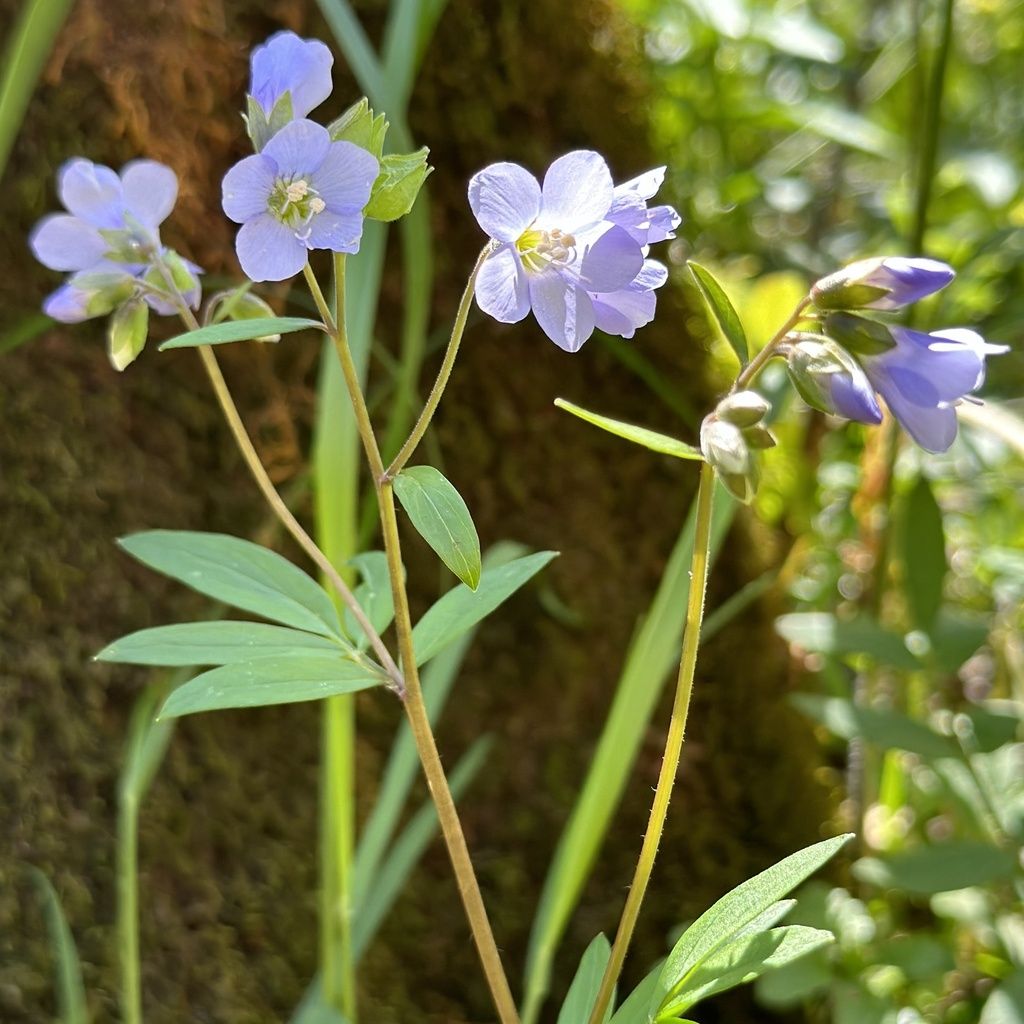
Flower profile
Jacob's ladder
Polemonium reptans
Jacob's ladder (Polemonium reptans) is a low shrub in the Polemoniaceae family, native in the lower 48 states, blooming mostly April–May across the U.S.
Jacob's ladder is a wildflower that USDA PLANTS lists as native in the lower 48 states. It's on our flower lists for 6 states, and across the U.S. it's most often seen in bloom in April–May.
*iNaturalist research-grade observations, as of October 17, 2026.
On our lists for: Delaware, Illinois, Indiana, Iowa, Kentucky, Ohio
Quick look
Polemonium reptans is a perennial herbaceous plant native to eastern North America. Common names include spreading Jacob's ladder, creeping Jacob's ladder, false Jacob's ladder, abscess root, American Greek valerian, blue bells, stairway to heaven, and sweatroot.
- It belongs to the Polemoniaceae family. iNaturalist
- USDA PLANTS describes it as an herb (forb) / a subshrub with a perennial life cycle. USDA PLANTS
- USDA PLANTS lists it as native in the lower 48 states and records it in 30 states. USDA PLANTS
- NatureServe lists it as native to Illinois, Ohio, Kentucky, Indiana, Iowa and Delaware. NatureServe
- In Illinois, most iNaturalist sightings of it in flower come in April–May. iNaturalist
- In Ohio, most iNaturalist sightings of it in flower come in April–May. iNaturalist
- iNaturalist has 2,662 research-grade sightings of it in Illinois, ranking #67 among the 180 flowers on our Illinois list. iNaturalist
- iNaturalist has 2,140 research-grade sightings of it in Ohio, ranking #84 among the 186 flowers on our Ohio list. iNaturalist
- iNaturalist has 1,064 research-grade sightings of it in Kentucky, ranking #55 among the 178 flowers on our Kentucky list. iNaturalist
When does it bloom?
Conservation status
- Federal (U.S. ESA)
- Not listed No U.S. Endangered Species Act listing in the USFWS ECOS database. USFWS ECOS
- NatureServe global
- G5 Secure worldwide. NatureServe
- State rare plant lists
- Not listed Not on the official rare plant list in 5 of our 6 states.
See each state
- Illinois
- Not listed Not on Illinois List of Endangered and Threatened Flora (17 Ill. Adm. Code 1050), per the Endangered Species Protection Board's 2025 checklist. NatureServe: SNR, not yet ranked in Illinois. IL E&T checklist 2025
- Ohio
- Not listed Not on Ohio endangered and threatened plants (Ohio Adm. Code 1501:18-1-03, eff. Dec. 26, 2024). NatureServe: SNR, not yet ranked in Ohio. OAC 1501:18-1-03
- Kentucky
- Not listed Not on Kentucky endangered and threatened plant lists (400 KAR 3:040, eff. 2026). NatureServe: SNR, not yet ranked in Kentucky. 400 KAR 3:040
- Iowa
- Not listed Not on Iowa endangered, threatened and special concern plants (Iowa Admin. Code r. 571-77.3). NatureServe: S4, apparently secure in Iowa. IAC 571-77.3
- Delaware
- Not listed Not on Rare and Uncommon Plants of Delaware (DNREC, 2024; informational, Delaware has no state plant-protection list). NatureServe: S4, apparently secure in Delaware. DE rare plants 2024
- Indiana
- No list Indiana has no state law listing endangered or threatened plants (the DNR keeps a rare plant list, but it isn't regulatory), so we show NatureServe's Indiana ranks instead. NatureServe: SNR, not yet ranked in Indiana.
- Rare elsewhere
- Other states where NatureServe ranks it rare or missing: KS (S2), MI (S2), MS (S2), NC (S1), NE (S1). (S1 critically imperiled, S2 imperiled, SH possibly extirpated, SX presumed extirpated.)
Checked October 17, 2026. Rankings and lists can change, so follow the links for the latest.
Can you eat it?
None of the sources we checked (NC State Extension (no edibility or poison notes on its page), USDA PLANTS) say whether it's edible or poisonous for people. NC State Extension
It isn't on the ASPCA plant list, and NC State Extension doesn't flag it for pets.
🌿 Never eat a wild plant unless you're certain of its ID; this isn't medical advice. Worried about a person? Call Poison Control at 1-800-222-1222. Worried about a pet? Call your vet.
Where does it grow?
USDA PLANTS records jacob's ladder in 30 states plus Washington, D.C.
recorded by USDA PLANTS on our state lists not recorded
See the full list of states
Alabama, Arkansas, Connecticut, Delaware, Georgia, Illinois, Indiana, Iowa, Kansas, Kentucky, Maryland, Massachusetts, Michigan, Minnesota, Mississippi, Missouri, New Hampshire, New Jersey, New York, North Carolina, Ohio, Oklahoma, Pennsylvania, Rhode Island, South Dakota, Tennessee, Vermont, Virginia, West Virginia, Wisconsin; District of Columbia.
Illinois counties with USDA records: Adams, Alexander, Boone, Brown, Bureau, Calhoun, Carroll, Champaign, Clark, Clay, Coles, Cook, Crawford, Cumberland, DeKalb, Douglas, DuPage, Edgar, Edwards, Effingham, Fayette, Ford, Franklin, Fulton, Gallatin, Greene, Grundy, Hancock, Hardin, Henderson, Iroquois, Jackson, Jasper, Jefferson, Jersey, Jo Daviess, Johnson, Kane, Kankakee, Kendall, Knox, LaSalle, Lake, Lawrence, Lee, Livingston, Macoupin, Madison, Marion, Massac, McDonough, McHenry, McLean, Montgomery, Ogle, Peoria, Perry, Pike, Pope, Pulaski, Putnam, Randolph, Richland, Rock Island, Saline, Sangamon, Schuyler, Shelby, St. Clair, Stark, Stephenson, Union, Vermilion, Wabash, Warren, Washington, Wayne, White, Whiteside, Will, Williamson, Winnebago.
Ohio counties with USDA records: Adams, Allen, Ashland, Ashtabula, Athens, Auglaize, Belmont, Brown, Butler, Carroll, Champaign, Clark, Clermont, Columbiana, Coshocton, Crawford, Cuyahoga, Darke, Defiance, Delaware, Erie, Fairfield, Fayette, Franklin, Gallia, Geauga, Greene, Guernsey, Hamilton, Hancock, Hardin, Harrison, Henry, Highland, Hocking, Holmes, Huron, Jackson, Jefferson, Knox, Lake, Lawrence, Licking, Logan, Lorain, Madison, Mahoning, Marion, Medina, Meigs, Mercer, Miami, Monroe, Montgomery, Morgan, Morrow, Muskingum, Noble, Paulding, Perry, Pickaway, Pike, Portage, Preble, Putnam, Richland, Ross, Scioto, Seneca, Shelby, Stark, Summit, Trumbull, Tuscarawas, Union, Van Wert, Vinton, Warren, Washington, Wayne, Williams, Wood, Wyandot.
Kentucky counties with USDA records: Adair, Allen, Anderson, Barren, Bath, Boone, Boyd, Boyle, Breckinridge, Bullitt, Caldwell, Calloway, Campbell, Carlisle, Carroll, Carter, Casey, Christian, Clark, Crittenden, Edmonson, Estill, Fayette, Fleming, Franklin, Gallatin, Garrard, Grant, Graves, Grayson, Green, Greenup, Hardin, Hart, Henderson, Henry, Hickman, Jackson, Jefferson, Jessamine, Johnson, Kenton, Laurel, Lee, Lewis, Lyon, Madison, Marshall, Mason, McLean, Meade, Menifee, Metcalfe, Monroe, Montgomery, Morgan, Nelson, Nicholas, Oldham, Owen, Owsley, Pendleton, Powell, Pulaski, Rockcastle, Rowan, Scott, Shelby, Taylor, Todd, Trigg, Trimble, Union, Warren, Washington, Wayne, Wolfe, Woodford.
Names, range and relatives
Native status by region (USDA PLANTS): Canada: Native; Lower 48 states: Native.
County records: USDA PLANTS lists it in 715 counties across 28 states; the most are in Missouri (92), Ohio (83), Illinois (82).
Other Polemonium on Bloomipedia (2): Sky pilot, Tall jacob's-ladder.
More from the Polemoniaceae family (14 on Bloomipedia; most observed first): Blue phlox, Scarlet gilia, Fall phlox, Prairie phlox, Grand collomia, Longleaf phlox, Spiny phlox, Narrow-leaf mountain trumpet.
More Illinois flowers
Sources
- USDA, NRCS. PLANTS Database, profile PORE2.
- iNaturalist, Polemonium reptans: taxonomy, research-grade observation counts and “Flowering” annotations, retrieved October 17, 2026.
- Wikipedia, Polemonium reptans (lead quoted under CC BY-SA 4.0).
- State rare and invasive plant lists (11):
Show all 11 state lists
- Illinois: Illinois List of Endangered and Threatened Flora (17 Ill. Adm. Code 1050), per the Endangered Species Protection Board's 2025 checklist.
- Illinois: Illinois Official List of Exotic Weeds (17 Ill. Adm. Code 1100.30, Illinois Exotic Weed Act).
- Ohio: Ohio endangered and threatened plants (Ohio Adm. Code 1501:18-1-03, eff. Dec. 26, 2024).
- Ohio: Ohio invasive plant species (Ohio Adm. Code 901:5-30-01).
- Kentucky: Kentucky endangered and threatened plant lists (400 KAR 3:040, eff. 2026).
- Kentucky: Kentucky noxious weeds and invasive plants on state rights-of-way (KRS 176.051; species list from the Kentucky Transportation Cabinet).
- Indiana: Indiana prohibited invasive terrestrial plants (312 IAC 18-3-25).
- Iowa: Iowa endangered, threatened and special concern plants (Iowa Admin. Code r. 571-77.3).
- Iowa: Iowa noxious weeds (Iowa Code § 317.1A).
- Delaware: Rare and Uncommon Plants of Delaware (DNREC, 2024; informational, Delaware has no state plant-protection list).
- Delaware: Delaware Invasive Plant List (3 Del. Admin. Code § 806-3.0).
- USFWS, ECOS species database (ESA listing check), October 17, 2026.
- NatureServe Explorer, Polemonium reptans (global and state ranks).
- Edibility and toxicity: NC State Extension.
- Photo: wilderbombyx via iNaturalist · CC0 · resized.