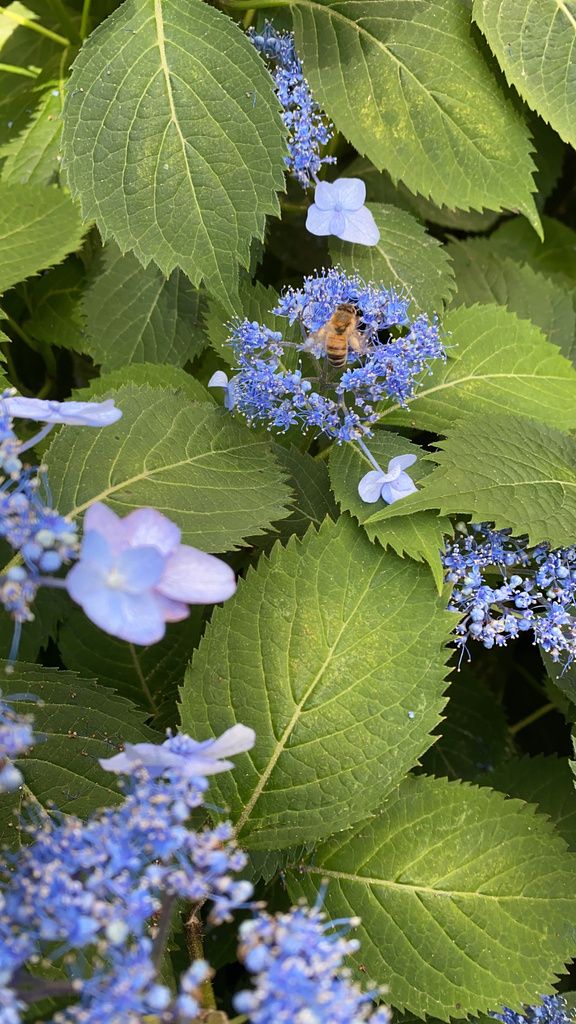
Flowering shrub
Mountain hydrangea
Hydrangea serrata
Mountain hydrangea is a popular flowering shrub. It's on our flower lists for 21 states.
*iNaturalist research-grade observations, as of October 23, 2026. Planted garden shrubs are mostly excluded from research grade.
On our lists for: California, Colorado, Connecticut, Delaware, Georgia, Illinois, Maine, Maryland, Massachusetts, Michigan, New Hampshire, New Jersey, New York, North Carolina, Oregon, Pennsylvania, Rhode Island, South Carolina, Tennessee, Virginia, Washington
Quick look
Hydrangea serrata is a species of flowering plant in the family Hydrangeaceae, native to mountainous regions of Korea and Japan. Common names include mountain hydrangea and tea of heaven. Growing to 1.2 m (4 ft) tall and broad, it is a deciduous shrub with oval leaves and panicles of blue and pink flowers in summer and autumn (fall).
- It belongs to the Hydrangeaceae family. iNaturalist
- iNaturalist has 4 research-grade sightings of it in Oregon, ranking #128 among the 184 flowers on our Oregon list. iNaturalist
- iNaturalist has 3 research-grade sightings of it in Georgia, ranking #162 among the 183 flowers on our Georgia list. iNaturalist
- iNaturalist has 3 research-grade sightings of it in Washington, ranking #129 among the 187 flowers on our Washington list. iNaturalist
Mountain hydrangea gift ideas
Handmade mountain hydrangea gifts from independent makers.
🌱 Sample spot. Handmade gift picks from independent shops will appear here once our shop partnership is approved. These cards are placeholders, not real products.
-
Placeholder
Mountain hydrangea art print
-
Placeholder
Mountain hydrangea greeting card
-
Placeholder
Mountain hydrangea mug
-
Placeholder
Mountain hydrangea earrings
-
Placeholder
Mountain hydrangea embroidery pattern
-
Placeholder
Mountain hydrangea sticker
When does it bloom?
Not enough flowering records on iNaturalist to chart yet.
Bloom time in each of our 21 states
| State | Type | Peak bloom | Sightings* |
|---|---|---|---|
| Oregon | 🌷 Garden | few records | 4 |
| Georgia | 🌷 Garden | few records | 3 |
| Washington | 🌷 Garden | few records | 3 |
| California | 🌷 Garden | few records | 1 |
| South Carolina | 🌷 Garden | few records | 1 |
| Tennessee | 🌷 Garden | few records | 1 |
| New Hampshire | 🌷 Garden | few records | 0 |
| Colorado | 🌷 Garden | few records | 0 |
| Connecticut | 🌷 Garden | few records | 0 |
| Delaware | 🌷 Garden | few records | 0 |
| Illinois | 🌷 Garden | few records | 0 |
| Massachusetts | 🌷 Garden | few records | 0 |
| Maryland | 🌷 Garden | few records | 0 |
| Maine | 🌷 Garden | few records | 0 |
| Michigan | 🌷 Garden | few records | 0 |
| North Carolina | 🌷 Garden | few records | 0 |
| New Jersey | 🌷 Garden | few records | 0 |
| New York | 🌷 Garden | few records | 0 |
| Pennsylvania | 🌷 Garden | few records | 0 |
| Rhode Island | 🌷 Garden | few records | 0 |
| Virginia | 🌷 Garden | few records | 0 |
Conservation status
- Federal (U.S. ESA)
- Not listed No U.S. Endangered Species Act listing in the USFWS ECOS database. USFWS ECOS
- NatureServe
- Unknown We couldn't find this name in NatureServe Explorer. NatureServe
- Oregon
- Not listed Not on Oregon endangered and threatened plants (OAR 603-073-0070). OAR 603-073-0070
- Georgia
- Not listed Not on Georgia protected plants (Ga. Comp. R. & Regs. 391-4-10-.09; a 2026 update is proposed). Ga. R. 391-4-10-.09
- Washington
- No list Washington has no state law listing endangered or threatened plants (the Washington Natural Heritage Program's rare plant list isn't regulatory), so we show NatureServe's Washington ranks instead.
- California
- Not listed Not on California state-listed endangered, threatened and rare plants (14 CCR § 670.2), per CDFW's CNDDB list (July 2026). CNDDB listed plants (July 2026)
- South Carolina
- No list South Carolina has no state law listing endangered or threatened plants, so we show NatureServe's South Carolina ranks instead.
- Tennessee
- Not listed Not on Tennessee endangered plants (Tenn. Comp. R. & Regs. 0400-06-02-.04, Rare Plant Protection and Conservation Act). TN rule 0400-06-02-.04
- New Hampshire
- Not listed Not on New Hampshire Official Rare Plants List (Ncr 312, eff. Jan 1, 2020). NH Ncr 312
- Colorado
- No list Colorado has no state law listing endangered or threatened plants, so we show NatureServe's Colorado ranks instead.
- Connecticut
- Not listed Not on Connecticut Endangered, Threatened and Special Concern Plants (RCSA 26-306; 2015 list). CT E/T/SC list
- Delaware
- Not listed Not on Rare and Uncommon Plants of Delaware (DNREC, 2024; informational, Delaware has no state plant-protection list). DE rare plants 2024
- Illinois
- Not listed Not on Illinois List of Endangered and Threatened Flora (17 Ill. Adm. Code 1050), per the Endangered Species Protection Board's 2025 checklist. IL E&T checklist 2025
- Massachusetts
- Not listed Not on Massachusetts Endangered Species Act list (321 CMR 10.90). MESA list
- Maryland
- Not listed Not on Maryland threatened and endangered plants (COMAR 08.03.08.05, .06 and .08). COMAR 08.03.08
- Maine
- Not listed Not on Maine Rare Plant List (Maine Natural Areas Program, 2021). E and T are Maine's official endangered and threatened plants (12 M.R.S.); SC and PE are tracking categories. Maine rare plant list
- Michigan
- Not listed Not on Michigan endangered and threatened plants (Mich. Admin. Code R 299.1028, eff. March 20, 2023). R 299.1028
- North Carolina
- Not listed Not on North Carolina Protected Plant Species List (02 NCAC 48F .0301). 02 NCAC 48F .0301
- New Jersey
- Not listed Not on New Jersey Endangered Plant Species List (N.J.A.C. 7:5C-5.1). N.J.A.C. 7:5C-5.1
- New York
- Not listed Not on New York protected native plants (6 NYCRR § 193.3). 6 NYCRR § 193.3
- Pennsylvania
- Not listed Not on Pennsylvania classified native plants (17 Pa. Code Ch. 45, Subchapter B, as amended 2023). 17 Pa. Code Ch. 45
- Rhode Island
- Not listed Not on Rhode Island Rare Plants 2016 (RI Natural History Survey, from the RI Wildlife Action Plan; informational, Rhode Island has no state plant-protection listing law). RI rare plants 2016
- Virginia
- Not listed Not on Virginia endangered and threatened plant and insect species (2VAC5-320-10). 2VAC5-320-10
Checked October 23, 2026. Rankings and lists can change, so follow the links for the latest.
Can you eat it?
NC State Extension notes: “Leaves can be used to make a sweet tea. The leaves can also be distilled to create a sweetener.” NC State Extension
NC State Extension flags it as a problem for cats, dogs and horses. It isn't on the ASPCA plant list. NC State Extension
🌿 Never eat a wild plant unless you're certain of its ID; this isn't medical advice. Worried about a person? Call Poison Control at 1-800-222-1222. Worried about a pet? Call your vet.
Where does it grow?
USDA PLANTS has no state-by-state distribution for this name, so we can't map it yet.
More Oregon flowers
Sources
- USDA PLANTS: no profile matched this name.
- iNaturalist, Hydrangea serrata: taxonomy, research-grade observation counts and “Flowering” annotations, retrieved October 23, 2026.
- Wikipedia, Hydrangea serrata (lead quoted under CC BY-SA 4.0).
- Oregon: Oregon endangered and threatened plants (OAR 603-073-0070).
- Oregon: Oregon noxious weed quarantine, A and B weeds (OAR 603-052-1200).
- Georgia: Georgia protected plants (Ga. Comp. R. & Regs. 391-4-10-.09; a 2026 update is proposed).
- Washington: Washington State noxious weed list (WAC 16-750-005, -011, -015).
- California: California state-listed endangered, threatened and rare plants (14 CCR § 670.2), per CDFW's CNDDB list (July 2026).
- California: California noxious weed species (3 CCR § 4500).
- South Carolina: South Carolina State Plant Pest List, plants (S.C. Code Regs. 27-135; Clemson Dept. of Plant Industry).
- Tennessee: Tennessee endangered plants (Tenn. Comp. R. & Regs. 0400-06-02-.04, Rare Plant Protection and Conservation Act).
- Tennessee: Tennessee Pest Plant List (Tenn. Comp. R. & Regs. 0080-06-24-.02).
- New Hampshire: New Hampshire Official Rare Plants List (Ncr 312, eff. Jan 1, 2020).
- New Hampshire: NH Prohibited Invasive Species List (Agr 3800, Table 3800.1).
- Colorado: Colorado noxious weed lists A, B and C (8 CCR 1206-2, eff. May 15, 2025).
- Connecticut: Connecticut Endangered, Threatened and Special Concern Plants (RCSA 26-306; 2015 list).
- Connecticut: Connecticut prohibited invasive plants (Conn. Gen. Stat. § 22a-381d).
- Delaware: Rare and Uncommon Plants of Delaware (DNREC, 2024; informational, Delaware has no state plant-protection list).
- Delaware: Delaware Invasive Plant List (3 Del. Admin. Code § 806-3.0).
- Illinois: Illinois List of Endangered and Threatened Flora (17 Ill. Adm. Code 1050), per the Endangered Species Protection Board's 2025 checklist.
- Illinois: Illinois Official List of Exotic Weeds (17 Ill. Adm. Code 1100.30, Illinois Exotic Weed Act).
- Massachusetts: Massachusetts Endangered Species Act list (321 CMR 10.90).
- Massachusetts: Massachusetts Prohibited Plant List (MDAR) (Text from MDAR's 2023 scientific-name PDF (mass.gov blocks automated downloads); 2024-2026 additions listed on the mass.gov page: Alnus glutinosa, Pyrus calleryana, Miscanthus sinensis, Aralia elata, Rhodotypos scandens, Symplocos paniculata.).
- Maryland: Maryland threatened and endangered plants (COMAR 08.03.08.05, .06 and .08).
- Maryland: Maryland Prohibited Invasive Plant List (COMAR 15.06.04.06; MDA, updated July 2026).
- Maine: Maine Rare Plant List (Maine Natural Areas Program, 2021). E and T are Maine's official endangered and threatened plants (12 M.R.S.); SC and PE are tracking categories.
- Maine: Maine Do Not Sell invasive plant list (01-001 C.M.R. ch. 273).
- Michigan: Michigan endangered and threatened plants (Mich. Admin. Code R 299.1028, eff. March 20, 2023).
- Michigan: Michigan prohibited and restricted species (NREPA Part 413 and the 2026 Invasive Species Order), as listed by Michigan's Invasive Species Program.
- North Carolina: North Carolina Protected Plant Species List (02 NCAC 48F .0301).
- North Carolina: North Carolina Noxious Weed List (02 NCAC 48A .1702) (the list names any non-native Lythrum; we apply it to purple loosestrife (Lythrum salicaria), which isn't native).
- New Jersey: New Jersey Endangered Plant Species List (N.J.A.C. 7:5C-5.1).
- New Jersey: New Jersey prohibited invasive plant species (Invasive Species Management Act; propagation banned from Jan 1, 2027, sale from Jan 1, 2030).
- New York: New York protected native plants (6 NYCRR § 193.3).
- New York: New York prohibited and regulated invasive species (6 NYCRR Part 575).
- Pennsylvania: Pennsylvania classified native plants (17 Pa. Code Ch. 45, Subchapter B, as amended 2023).
- Pennsylvania: Pennsylvania Noxious Weed List (3 Pa.C.S. § 1519, PA Dept. of Agriculture) (PDA's page spells garlic mustard “Allaria petiolata”; we match it as Alliaria petiolata).
- Rhode Island: Rhode Island Rare Plants 2016 (RI Natural History Survey, from the RI Wildlife Action Plan; informational, Rhode Island has no state plant-protection listing law).
- Virginia: Virginia endangered and threatened plant and insect species (2VAC5-320-10).
- Virginia: Virginia noxious weeds (2VAC5-317-20, Tier 1, 2 and 3).
- USFWS, ECOS species database (ESA listing check), October 23, 2026.
- Edibility and toxicity: NC State Extension.
- Photo: nebrooks via iNaturalist · CC BY 4.0 · resized.