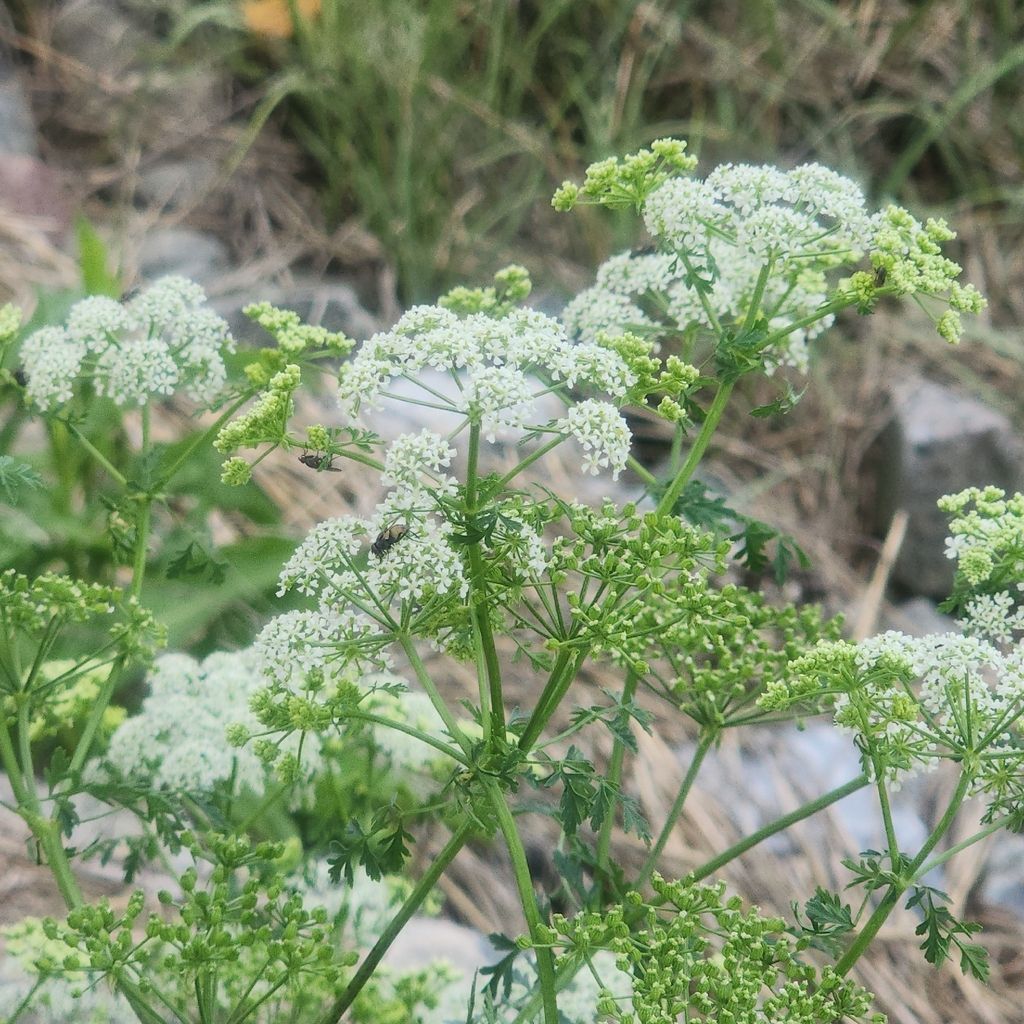
Flower profile
Poison hemlock
Conium maculatum
Poison hemlock is a wildflower that USDA PLANTS lists as introduced in the lower 48 states. It's on our flower lists for 12 states, and across the U.S. it's most often seen in bloom in April–July.
*iNaturalist research-grade observations, as of October 17, 2026.
On our lists for: California, Delaware, Indiana, Iowa, Kansas, Kentucky, Missouri, Nebraska, Ohio, Oregon, Pennsylvania, Washington
Quick look
Conium maculatum, commonly known as hemlock or poison hemlock, is a highly poisonous flowering plant and a nitrophile weed species in the carrot family Apiaceae.
- It belongs to the Apiaceae family. iNaturalist
- USDA PLANTS describes it as an herb (forb) with a biennial life cycle. USDA PLANTS
- USDA PLANTS lists it as introduced in the lower 48 states and records it in 46 states. USDA PLANTS
- In California, most iNaturalist sightings of it in flower come in April–September. iNaturalist
- In Ohio, most iNaturalist sightings of it in flower come in May–June. iNaturalist
- iNaturalist has 16,110 research-grade sightings of it in California, ranking #43 among the 110 flowers on our California list. iNaturalist
- iNaturalist has 2,939 research-grade sightings of it in Ohio, ranking #56 among the 109 flowers on our Ohio list. iNaturalist
- iNaturalist has 2,549 research-grade sightings of it in Pennsylvania, ranking #82 among the 111 flowers on our Pennsylvania list. iNaturalist
State flower gift ideas
This one is a regulated invasive plant, so here are state flower gifts instead.
🌱 Sample spot. Handmade gift picks from independent shops will appear here once our shop partnership is approved. These cards are placeholders, not real products.
-
Placeholder
State flower print
-
Placeholder
Birth-flower necklace
-
Placeholder
Wildflower seed favors
-
Placeholder
Botanical tea towel
-
Placeholder
Pressed-flower frame
-
Placeholder
Flower-garden mug
When does it bloom?
Bloom time in each of our 12 states
| State | Type | Peak bloom | Sightings* |
|---|---|---|---|
| California | Introduced | April–September | 16,110 |
| Ohio | Introduced | May–June | 2,939 |
| Pennsylvania | Introduced | May–June | 2,549 |
| Washington | Introduced | May–July | 2,360 |
| Oregon | Introduced | May–July | 1,662 |
| Kentucky | Introduced | May–June | 989 |
| Indiana | Introduced | May–June | 790 |
| Missouri | Introduced | May–June | 730 |
| Iowa | Introduced | May–July | 537 |
| Nebraska | Introduced | May–June | 471 |
| Kansas | Introduced | May–July | 456 |
| Delaware | Introduced | May–June | 154 |
Conservation status
- Federal (U.S. ESA)
- Not listed No U.S. Endangered Species Act listing in the USFWS ECOS database. USFWS ECOS
- NatureServe global
- G5 Secure worldwide. NatureServe
- California
- Not listed Not on California state-listed endangered, threatened and rare plants (14 CCR § 670.2), per CDFW's CNDDB list (July 2026). NatureServe: SNA, not applicable (usually because it isn't native there) in California. CNDDB listed plants (July 2026)
- Ohio
- Not listed Not on Ohio endangered and threatened plants (Ohio Adm. Code 1501:18-1-03, eff. Dec. 26, 2024). NatureServe: SNA, not applicable (usually because it isn't native there) in Ohio. OAC 1501:18-1-03
- Pennsylvania
- Not listed Not on Pennsylvania classified native plants (17 Pa. Code Ch. 45, Subchapter B, as amended 2023). NatureServe: SNA, not applicable (usually because it isn't native there) in Pennsylvania. 17 Pa. Code Ch. 45
- Washington
- No list Washington has no state law listing endangered or threatened plants (the Washington Natural Heritage Program's rare plant list isn't regulatory), so we show NatureServe's Washington ranks instead. NatureServe: SNA, not applicable (usually because it isn't native there) in Washington.
- Oregon
- Not listed Not on Oregon endangered and threatened plants (OAR 603-073-0070). NatureServe: SNA, not applicable (usually because it isn't native there) in Oregon. OAR 603-073-0070
- Kentucky
- Not listed Not on Kentucky endangered and threatened plant lists (400 KAR 3:040, eff. 2026). NatureServe: SNA, not applicable (usually because it isn't native there) in Kentucky. 400 KAR 3:040
- Indiana
- No list Indiana has no state law listing endangered or threatened plants (the DNR keeps a rare plant list, but it isn't regulatory), so we show NatureServe's Indiana ranks instead. NatureServe: SNA, not applicable (usually because it isn't native there) in Indiana.
- Missouri
- Not listed Not on Missouri Wildlife Code endangered species (3 CSR 10-4.111), plants. NatureServe: SNA, not applicable (usually because it isn't native there) in Missouri. 3 CSR 10-4.111
- Iowa
- Not listed Not on Iowa endangered, threatened and special concern plants (Iowa Admin. Code r. 571-77.3). NatureServe: SNA, not applicable (usually because it isn't native there) in Iowa. IAC 571-77.3
- Nebraska
- Not listed Not on Nebraska threatened and endangered species (163 Neb. Admin. Code ch. 4, § 004). NatureServe: SNA, not applicable (usually because it isn't native there) in Nebraska. 163 NAC 4-004
- Kansas
- No list Kansas's endangered and threatened list (K.A.R. 115-15-1) covers animals only, so we show NatureServe's Kansas ranks for plants. NatureServe: SNA, not applicable (usually because it isn't native there) in Kansas.
- Delaware
- Not listed Not on Rare and Uncommon Plants of Delaware (DNREC, 2024; informational, Delaware has no state plant-protection list). NatureServe: SNA, not applicable (usually because it isn't native there) in Delaware. DE rare plants 2024
- Rare elsewhere
- No other U.S. state ranks it S1, S2, SH or SX.
Checked October 17, 2026. Rankings and lists can change, so follow the links for the latest.
Can you eat it?
NC State Extension lists it as poisonous to humans (severity: high). Poisonous parts: bark, flowers, fruits, leaves, roots, sap/juice, seeds, stems. Symptoms they list: “HIGHLY TOXIC, MAY BE FATAL IF EATEN! Delivery by ingestion. Salivation, vomiting, diarrhea, muscular weakness, paralysis, nervousness, trembling, dilation of pupils, weak pulse, convulsions, coma. People with highly sensitive skin may experience contact…” NC State Extension
ASPCA's entry “Poison Hemlock” (Conium maculatum) lists it as toxic to dogs, cats and horses. Signs include: Agitation, tremors, drooling, diarrhea, paralysis, death Credit: William & Wilma Follette @ USDA-NRCS PLANTS Database / USDA NRCS. 1992. Western wetland flora: Field office guide to plant species… ASPCA
🌿 Never eat a wild plant unless you're certain of its ID; this isn't medical advice. Worried about a person? Call Poison Control at 1-800-222-1222. Worried about a pet? Call your vet.
Where does it grow?
USDA PLANTS records poison hemlock in 46 states plus Washington, D.C.
recorded by USDA PLANTS on our state lists not recorded
See the full list of states
Alabama, Arizona, Arkansas, California, Colorado, Connecticut, Delaware, Georgia, Idaho, Illinois, Indiana, Iowa, Kansas, Kentucky, Louisiana, Maine, Maryland, Massachusetts, Michigan, Minnesota, Missouri, Montana, Nebraska, Nevada, New Hampshire, New Jersey, New Mexico, New York, North Carolina, North Dakota, Ohio, Oklahoma, Oregon, Pennsylvania, Rhode Island, South Carolina, South Dakota, Tennessee, Texas, Utah, Vermont, Virginia, Washington, West Virginia, Wisconsin, Wyoming; District of Columbia.
California counties with USDA records: Alameda, Butte, Contra Costa, Del Norte, Glenn, Humboldt, Kern, Los Angeles, Marin, Mendocino, Merced, Modoc, Mono, Monterey, Napa, Nevada, Orange, Placer, Plumas, Riverside, Sacramento, San Bernardino, San Diego, San Francisco, San Joaquin, San Luis Obispo, San Mateo, Santa Barbara, Santa Clara, Santa Cruz, Shasta, Siskiyou, Solano, Sonoma, Tehama, Tuolumne, Ventura, Yolo.
Ohio counties with USDA records: Adams, Ashland, Ashtabula, Auglaize, Butler, Champaign, Clark, Clinton, Coshocton, Crawford, Cuyahoga, Darke, Delaware, Erie, Fairfield, Fayette, Greene, Hamilton, Highland, Holmes, Knox, Lake, Lawrence, Licking, Lorain, Madison, Meigs, Mercer, Miami, Monroe, Montgomery, Ottawa, Pickaway, Pike, Putnam, Richland, Ross, Scioto, Stark, Trumbull, Union, Warren, Washington, Wayne, Williams, Wood, Wyandot.
Pennsylvania counties with USDA records: Adams, Allegheny, Beaver, Bedford, Berks, Blair, Bradford, Bucks, Centre, Chester, Crawford, Cumberland, Delaware, Erie, Franklin, Fulton, Greene, Huntingdon, Juniata, Lackawanna, Lancaster, Lehigh, Luzerne, Mifflin, Montgomery, Montour, Northampton, Philadelphia, Potter, Snyder, Tioga, Washington, Wayne, Wyoming, York.
More California flowers
Sources
- USDA, NRCS. PLANTS Database, profile COMA2.
- iNaturalist, Conium maculatum: taxonomy, research-grade observation counts and “Flowering” annotations, retrieved October 17, 2026.
- Wikipedia, Conium maculatum (lead quoted under CC BY-SA 4.0).
- California: California state-listed endangered, threatened and rare plants (14 CCR § 670.2), per CDFW's CNDDB list (July 2026).
- California: California noxious weed species (3 CCR § 4500).
- Ohio: Ohio endangered and threatened plants (Ohio Adm. Code 1501:18-1-03, eff. Dec. 26, 2024).
- Ohio: Ohio invasive plant species (Ohio Adm. Code 901:5-30-01).
- Pennsylvania: Pennsylvania classified native plants (17 Pa. Code Ch. 45, Subchapter B, as amended 2023).
- Pennsylvania: Pennsylvania Noxious Weed List (3 Pa.C.S. § 1519, PA Dept. of Agriculture) (PDA's page spells garlic mustard “Allaria petiolata”; we match it as Alliaria petiolata).
- Washington: Washington State noxious weed list (WAC 16-750-005, -011, -015).
- Oregon: Oregon endangered and threatened plants (OAR 603-073-0070).
- Oregon: Oregon noxious weed quarantine, A and B weeds (OAR 603-052-1200).
- Kentucky: Kentucky endangered and threatened plant lists (400 KAR 3:040, eff. 2026).
- Kentucky: Kentucky noxious weeds and invasive plants on state rights-of-way (KRS 176.051; species list from the Kentucky Transportation Cabinet).
- Indiana: Indiana prohibited invasive terrestrial plants (312 IAC 18-3-25).
- Missouri: Missouri Wildlife Code endangered species (3 CSR 10-4.111), plants.
- Missouri: Missouri noxious weed list (2 CSR 70-45.005).
- Iowa: Iowa endangered, threatened and special concern plants (Iowa Admin. Code r. 571-77.3).
- Iowa: Iowa noxious weeds (Iowa Code § 317.1A).
- Nebraska: Nebraska threatened and endangered species (163 Neb. Admin. Code ch. 4, § 004).
- Nebraska: Nebraska noxious weeds (25 Neb. Admin. Code ch. 10, § 001.02).
- Kansas: Kansas noxious weeds (K.A.R. 4-8-44, as amended 2026).
- Delaware: Rare and Uncommon Plants of Delaware (DNREC, 2024; informational, Delaware has no state plant-protection list).
- Delaware: Delaware Invasive Plant List (3 Del. Admin. Code § 806-3.0).
- USFWS, ECOS species database (ESA listing check), October 17, 2026.
- NatureServe Explorer, Conium maculatum (global and state ranks).
- Edibility and toxicity: NC State Extension; ASPCA.
- Photo: Peter A. Greenberg via iNaturalist · CC BY 4.0 · resized.