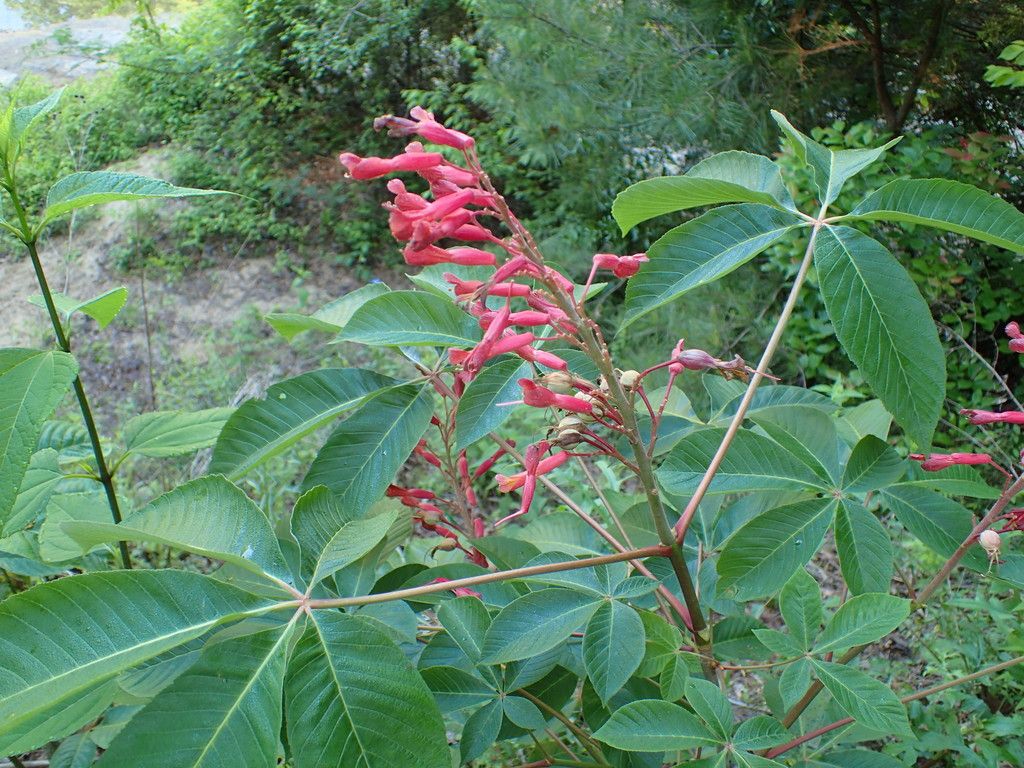
Flowering shrub
Red buckeye
Aesculus pavia
Red buckeye (Aesculus pavia) is a shrub in the Sapindaceae family, native in the lower 48 states, blooming mostly March–April across the U.S.
Red buckeye is a popular flowering shrub. It's on our flower lists for 32 states, and across the U.S. it's most often seen in bloom in March–April.
*iNaturalist research-grade observations, as of October 23, 2026. Our state lists also include states where people grow it in gardens, so they can outnumber USDA's wild-plant records. Planted garden shrubs are mostly excluded from research grade.
On our lists for: Alabama, Arkansas, California, Colorado, Connecticut, Delaware, Florida, Georgia, Illinois, Indiana, Kansas, Kentucky, Louisiana, Maryland, Massachusetts, Michigan, Mississippi, Missouri, New Hampshire, New Jersey, New York, North Carolina, Ohio, Oklahoma, Pennsylvania, South Carolina, Tennessee, Texas, Virginia, Washington, West Virginia, Wisconsin
Quick look
Aesculus pavia, known as red buckeye or firecracker plant, is a species of deciduous flowering plant. The small tree or shrub is native to the southern and eastern parts of the United States, found from Illinois to Virginia in the north and from Texas to Florida in the south. It is hardy far to the north of its native range, with successful cultivation poleward to Arboretum Mustila in Finland.
- It belongs to the Sapindaceae family. iNaturalist
- USDA PLANTS describes it as a shrub / a tree with a perennial life cycle. USDA PLANTS
- USDA PLANTS lists it as native in the lower 48 states and records it in 18 states. USDA PLANTS
- In Texas, most iNaturalist sightings of it in flower come in March–April. iNaturalist
- In Alabama, most iNaturalist sightings of it in flower come in March–April. iNaturalist
- USDA PLANTS lists its flower color as red. USDA PLANTS
- USDA PLANTS gives its bloom period as late spring. USDA PLANTS
- USDA PLANTS lists a mature height of about 25 ft. USDA PLANTS
- iNaturalist has 6,300 research-grade sightings of it in Texas, ranking #103 among the 169 flowers on our Texas list. iNaturalist
- iNaturalist has 1,817 research-grade sightings of it in Alabama, ranking #14 among the 167 flowers on our Alabama list. iNaturalist
- iNaturalist has 1,625 research-grade sightings of it in Arkansas, ranking #9 among the 170 flowers on our Arkansas list. iNaturalist
When does it bloom?
Bloom time in the 32 states whose Bloomipedia list includes it
| State | Type | Peak bloom | Sightings* |
|---|---|---|---|
| Texas | 🌷 Garden | March–April | 6,300 |
| Alabama | 🌷 Garden | March–April | 1,817 |
| Arkansas | 🌷 Garden | March–May | 1,625 |
| Georgia | 🌷 Garden | March–April | 1,232 |
| Florida | 🌷 Garden | February–March | 1,117 |
| Tennessee | 🌷 Garden | April | 1,090 |
| Louisiana | 🌷 Garden | March–April | 1,070 |
| Mississippi | 🌷 Garden | March–April | 760 |
| South Carolina | 🌷 Garden | March–April | 650 |
| North Carolina | 🌷 Garden | March–May | 583 |
| Missouri | 🌷 Garden | few records (31) | 396 |
| Virginia | 🌷 Garden | April–May | 285 |
| Maryland | 🌷 Garden | few records (30) | 218 |
| Illinois | 🌷 Garden | few records (11) | 212 |
| Pennsylvania | 🌷 Garden | few records (13) | 171 |
| Ohio | 🌷 Garden | few records (17) | 143 |
| Kentucky | 🌷 Garden | few records (41) | 128 |
| New York | 🌷 Garden | few records (10) | 103 |
| New Jersey | 🌷 Garden | few records (11) | 67 |
| Oklahoma | 🌷 Garden | few records (5) | 47 |
| Delaware | 🌷 Garden | few records (4) | 20 |
| Indiana | 🌷 Garden | few records (6) | 16 |
| Massachusetts | 🌷 Garden | few records (1) | 14 |
| West Virginia | 🌷 Garden | few records (2) | 8 |
| Michigan | 🌷 Garden | few records (2) | 5 |
| Kansas | 🌷 Garden | no flowering records | 3 |
| Wisconsin | 🌷 Garden | no flowering records | 1 |
| New Hampshire | 🌷 Garden | no flowering records | 0 |
| California | 🌷 Garden | no flowering records | 0 |
| Colorado | 🌷 Garden | no flowering records | 0 |
| Connecticut | 🌷 Garden | no flowering records | 0 |
| Washington | 🌷 Garden | no flowering records | 0 |
Conservation status
- Federal (U.S. ESA)
- Not listed No U.S. Endangered Species Act listing in the USFWS ECOS database. USFWS ECOS
- NatureServe global
- G5 Secure worldwide. NatureServe
- State rare plant lists
- Not listed Not on the official rare plant list in 20 of our 32 states.
See each state
- Texas
- Not listed Not on Texas endangered and threatened plants (31 Tex. Admin. Code § 69.8), as listed by Texas Parks and Wildlife. NatureServe: SNR, not yet ranked in Texas. 31 TAC 69.8
- Georgia
- Not listed Not on Georgia protected plants (Ga. Comp. R. & Regs. 391-4-10-.09; a 2026 update is proposed). NatureServe: S5, secure in Georgia. Ga. R. 391-4-10-.09
- Florida
- Not listed Not on Florida Regulated Plant Index (Fla. Admin. Code 5B-40.0055). NatureServe: S4, apparently secure in Florida. FAC 5B-40.0055
- Tennessee
- Not listed Not on Tennessee endangered plants (Tenn. Comp. R. & Regs. 0400-06-02-.04, Rare Plant Protection and Conservation Act). NatureServe: SNR, not yet ranked in Tennessee. TN rule 0400-06-02-.04
- North Carolina
- Not listed Not on North Carolina Protected Plant Species List (02 NCAC 48F .0301). NatureServe: S4, apparently secure in North Carolina. 02 NCAC 48F .0301
- Missouri
- Not listed Not on Missouri Wildlife Code endangered species (3 CSR 10-4.111), plants. NatureServe: SNR, not yet ranked in Missouri. 3 CSR 10-4.111
- Virginia
- Not listed Not on Virginia endangered and threatened plant and insect species (2VAC5-320-10). NatureServe has no Virginia rank for it. 2VAC5-320-10
- Maryland
- Not listed Not on Maryland threatened and endangered plants (COMAR 08.03.08.05, .06 and .08). NatureServe has no Maryland rank for it. COMAR 08.03.08
- Illinois
- Not listed Not on Illinois List of Endangered and Threatened Flora (17 Ill. Adm. Code 1050), per the Endangered Species Protection Board's 2025 checklist. NatureServe: SNR, not yet ranked in Illinois. IL E&T checklist 2025
- Pennsylvania
- Not listed Not on Pennsylvania classified native plants (17 Pa. Code Ch. 45, Subchapter B, as amended 2023). NatureServe has no Pennsylvania rank for it. 17 Pa. Code Ch. 45
- Ohio
- Not listed Not on Ohio endangered and threatened plants (Ohio Adm. Code 1501:18-1-03, eff. Dec. 26, 2024). NatureServe has no Ohio rank for it. OAC 1501:18-1-03
- New York
- Not listed Not on New York protected native plants (6 NYCRR § 193.3). NatureServe has no New York rank for it. 6 NYCRR § 193.3
- New Jersey
- Not listed Not on New Jersey Endangered Plant Species List (N.J.A.C. 7:5C-5.1). NatureServe has no New Jersey rank for it. N.J.A.C. 7:5C-5.1
- Delaware
- Not listed Not on Rare and Uncommon Plants of Delaware (DNREC, 2024; informational, Delaware has no state plant-protection list). NatureServe has no Delaware rank for it. DE rare plants 2024
- Massachusetts
- Not listed Not on Massachusetts Endangered Species Act list (321 CMR 10.90). NatureServe has no Massachusetts rank for it. MESA list
- Michigan
- Not listed Not on Michigan endangered and threatened plants (Mich. Admin. Code R 299.1028, eff. March 20, 2023). NatureServe has no Michigan rank for it. R 299.1028
- Wisconsin
- Not listed Not on Wisconsin endangered and threatened species list (Wis. Admin. Code NR 27.03). NatureServe has no Wisconsin rank for it. NR 27.03
- New Hampshire
- Not listed Not on New Hampshire Official Rare Plants List (Ncr 312, eff. Jan 1, 2020). NatureServe has no New Hampshire rank for it. NH Ncr 312
- California
- Not listed Not on California state-listed endangered, threatened and rare plants (14 CCR § 670.2), per CDFW's CNDDB list (July 2026). NatureServe has no California rank for it. CNDDB listed plants (July 2026)
- Connecticut
- Not listed Not on Connecticut Endangered, Threatened and Special Concern Plants (RCSA 26-306; 2015 list). NatureServe has no Connecticut rank for it. CT E/T/SC list
- Alabama
- No list Alabama has no state law listing endangered or threatened plants, so we show NatureServe's Alabama ranks instead. NatureServe: SNR, not yet ranked in Alabama.
- Arkansas
- No list Arkansas has no state law listing endangered or threatened plants, so we show NatureServe's Arkansas ranks instead. NatureServe: SNR, not yet ranked in Arkansas.
- Louisiana
- No list Louisiana has no state list of endangered or threatened plants separate from the federal list, so we show federal status and NatureServe's Louisiana ranks. NatureServe: SNR, not yet ranked in Louisiana.
- Mississippi
- No list Mississippi has no state law listing endangered or threatened plants, so we show NatureServe's Mississippi ranks instead. NatureServe: SNR, not yet ranked in Mississippi.
- South Carolina
- No list South Carolina has no state law listing endangered or threatened plants, so we show NatureServe's South Carolina ranks instead. NatureServe: SNR, not yet ranked in South Carolina.
- Kentucky
- State threatened On Kentucky endangered and threatened plant lists (400 KAR 3:040, eff. 2026): state threatened. NatureServe: SNR, not yet ranked in Kentucky. 400 KAR 3:040
- Oklahoma
- No list Oklahoma has no state law listing endangered or threatened plants, so we show NatureServe's Oklahoma ranks instead. NatureServe: S2, imperiled in Oklahoma.
- Indiana
- No list Indiana has no state law listing endangered or threatened plants (the DNR keeps a rare plant list, but it isn't regulatory), so we show NatureServe's Indiana ranks instead. NatureServe has no Indiana rank for it.
- West Virginia
- No list West Virginia has no state law listing endangered or threatened plants (only federally listed species are protected), so we show NatureServe's West Virginia ranks instead. NatureServe: SNR, not yet ranked in West Virginia.
- Kansas
- No list Kansas's endangered and threatened list (K.A.R. 115-15-1) covers animals only, so we show NatureServe's Kansas ranks for plants. NatureServe has no Kansas rank for it.
- Colorado
- No list Colorado has no state law listing endangered or threatened plants, so we show NatureServe's Colorado ranks instead. NatureServe has no Colorado rank for it.
- Washington
- No list Washington has no state law listing endangered or threatened plants (the Washington Natural Heritage Program's rare plant list isn't regulatory), so we show NatureServe's Washington ranks instead. NatureServe has no Washington rank for it.
- Rare elsewhere
- No other U.S. state ranks it S1, S2, SH or SX.
Checked October 23, 2026. Rankings and lists can change, so follow the links for the latest.
Please don't pick or dig this flower: it's on Kentucky's rare plant list (state threatened); NatureServe ranks it S2 in Oklahoma. 400 KAR 3:040 NatureServe
Can you eat it?
NC State Extension lists it as poisonous to humans (severity: high). Poisonous parts: bark, flowers, fruits, leaves, seeds, stems. Symptoms they list: “Poisonous if ingested. Highly toxic, may be fatal if eaten. Symptoms may include muscle weakness and paralysis, dilated pupils, vomiting, diarrhea, depression, paralysis, and stupor.” NC State Extension
ASPCA's entry “Buckeye” (Aesculus spp), which covers the whole genus, lists it as toxic to dogs, cats and horses. Signs include: Severe vomiting and diarrhea, depression or excitement, dilated pupils, coma, convulsions… ASPCA
🌿 Never eat a wild plant unless you're certain of its ID; this isn't medical advice. Worried about a person? Call Poison Control at 1-800-222-1222. Worried about a pet? Call your vet.
Where does it grow?
USDA PLANTS records red buckeye in 18 states.
recorded by USDA PLANTS on our state lists not recorded
See the full list of states
Alabama, Arkansas, Florida, Georgia, Illinois, Indiana, Kentucky, Louisiana, Mississippi, Missouri, North Carolina, Ohio, Oklahoma, South Carolina, Tennessee, Texas, Virginia, West Virginia.
Texas counties with USDA records: Angelina, Austin, Bandera, Bastrop, Bexar, Bowie, Burleson, Cass, Cherokee, Colorado, Comal, DeWitt, Fayette, Fort Bend, Gonzales, Gregg, Grimes, Hardin, Harrison, Hays, Henderson, Houston, Kendall, Kerr, Marion, Matagorda, Medina, Morris, Nacogdoches, Newton, Polk, Real, Rusk, Sabine, San Augustine, Shelby, Titus, Travis, Upshur, Uvalde, Victoria, Washington, Wichita, Williamson.
Alabama counties with USDA records: Autauga, Baldwin, Barbour, Bibb, Blount, Bullock, Butler, Calhoun, Chambers, Chilton, Choctaw, Clarke, Clay, Cleburne, Colbert, Conecuh, Coosa, Covington, Crenshaw, Cullman, Dale, Dallas, DeKalb, Elmore, Escambia, Etowah, Fayette, Franklin, Geneva, Greene, Hale, Henry, Houston, Jefferson, Lamar, Lawrence, Lee, Limestone, Lowndes, Madison, Marengo, Marion, Marshall, Mobile, Monroe, Montgomery, Morgan, Perry, Pickens, Pike, Randolph, Russell, Shelby, Sumter, Talladega, Tuscaloosa, Walker, Wilcox, Winston.
Arkansas counties with USDA records: Arkansas, Ashley, Bradley, Calhoun, Chicot, Clark, Clay, Cleburne, Cleveland, Columbia, Conway, Craighead, Cross, Dallas, Desha, Drew, Faulkner, Fulton, Garland, Grant, Greene, Hempstead, Hot Spring, Howard, Independence, Izard, Jackson, Jefferson, Lafayette, Lawrence, Lee, Lincoln, Little River, Logan, Lonoke, Madison, Miller, Monroe, Montgomery, Nevada, Ouachita, Perry, Phillips, Pike, Poinsett, Polk, Pope, Prairie, Pulaski, Randolph, Saline, Sevier, Sharp, St. Francis, Stone, Union, Van Buren, White, Woodruff, Yell.
Growing conditions
USDA PLANTS gives Red buckeye a low shade tolerance, low drought tolerance and high moisture use. It is rated for soil pH 3.7 to 7.0 and winter lows down to -20 °F.
- Shade tolerance
- Low
- Drought tolerance
- Low
- Moisture use
- High
- Soil textures it is adapted to
- coarse, medium, fine
- Soil pH range
- 3.7 to 7.0
- Minimum temperature tolerated
- -20 °F
- Frost-free days needed (minimum)
- 180
- Annual precipitation range
- 36 to 65 inches
- Minimum root depth
- 20 inches
- Salinity tolerance
- None
- Fertility requirement
- Medium
- Growth rate
- Moderate
- Lifespan
- Long
- Active growth period
- Spring and Summer
- Fruit or seed
- Brown · Summer to Fall
- Can be propagated by
- bare root, container, seed
- Commercial availability
- No Known Source
From the USDA PLANTS characteristics data for AEPA. USDA ratings are general guidance for the species, not a guarantee for your garden.
Names, range and relatives
Native status by region (USDA PLANTS): Canada: Introduced; Lower 48 states: Native.
County records: USDA PLANTS lists it in 441 counties across 16 states; the most are in Arkansas (60), Alabama (59), Georgia (56).
Other Aesculus on Bloomipedia (1): Bottlebrush buckeye.
More from the Sapindaceae family (3 on Bloomipedia; most observed first): Western soapberry, Mexican buckeye.
More Texas flowers
Sources
- USDA, NRCS. PLANTS Database, profile AEPA.
- iNaturalist, Aesculus pavia: taxonomy, research-grade observation counts and “Flowering” annotations, retrieved October 23, 2026.
- Wikipedia, Aesculus pavia (lead quoted under CC BY-SA 4.0).
- State rare and invasive plant lists (51):
Show all 51 state lists
- Texas: Texas endangered and threatened plants (31 Tex. Admin. Code § 69.8), as listed by Texas Parks and Wildlife.
- Texas: Texas noxious and invasive plant list (4 Tex. Admin. Code § 19.300(a)).
- Alabama: Alabama noxious weeds (Ala. Admin. Code r. 80-10-14-.04).
- Arkansas: Arkansas State Plant Board noxious weeds and prohibited plants (2 CAR § 50-101).
- Georgia: Georgia protected plants (Ga. Comp. R. & Regs. 391-4-10-.09; a 2026 update is proposed).
- Florida: Florida Regulated Plant Index (Fla. Admin. Code 5B-40.0055).
- Florida: Florida Noxious Weed List (Fla. Admin. Code 5B-57.007).
- Tennessee: Tennessee endangered plants (Tenn. Comp. R. & Regs. 0400-06-02-.04, Rare Plant Protection and Conservation Act).
- Tennessee: Tennessee Pest Plant List (Tenn. Comp. R. & Regs. 0080-06-24-.02).
- Mississippi: Mississippi Noxious Weed List (2 Miss. Code R. 1-3-01-136.01).
- South Carolina: South Carolina State Plant Pest List, plants (S.C. Code Regs. 27-135; Clemson Dept. of Plant Industry).
- North Carolina: North Carolina Protected Plant Species List (02 NCAC 48F .0301).
- North Carolina: North Carolina Noxious Weed List (02 NCAC 48A .1702) (the list names any non-native Lythrum; we apply it to purple loosestrife (Lythrum salicaria), which isn't native).
- Missouri: Missouri Wildlife Code endangered species (3 CSR 10-4.111), plants.
- Missouri: Missouri noxious weed list (2 CSR 70-45.005).
- Virginia: Virginia endangered and threatened plant and insect species (2VAC5-320-10).
- Virginia: Virginia noxious weeds (2VAC5-317-20, Tier 1, 2 and 3).
- Maryland: Maryland threatened and endangered plants (COMAR 08.03.08.05, .06 and .08).
- Maryland: Maryland Prohibited Invasive Plant List (COMAR 15.06.04.06; MDA, updated July 2026).
- Illinois: Illinois List of Endangered and Threatened Flora (17 Ill. Adm. Code 1050), per the Endangered Species Protection Board's 2025 checklist.
- Illinois: Illinois Official List of Exotic Weeds (17 Ill. Adm. Code 1100.30, Illinois Exotic Weed Act).
- Pennsylvania: Pennsylvania classified native plants (17 Pa. Code Ch. 45, Subchapter B, as amended 2023).
- Pennsylvania: Pennsylvania Noxious Weed List (3 Pa.C.S. § 1519, PA Dept. of Agriculture) (PDA's page spells garlic mustard “Allaria petiolata”; we match it as Alliaria petiolata).
- Ohio: Ohio endangered and threatened plants (Ohio Adm. Code 1501:18-1-03, eff. Dec. 26, 2024).
- Ohio: Ohio invasive plant species (Ohio Adm. Code 901:5-30-01).
- Kentucky: Kentucky endangered and threatened plant lists (400 KAR 3:040, eff. 2026).
- Kentucky: Kentucky noxious weeds and invasive plants on state rights-of-way (KRS 176.051; species list from the Kentucky Transportation Cabinet).
- New York: New York protected native plants (6 NYCRR § 193.3).
- New York: New York prohibited and regulated invasive species (6 NYCRR Part 575).
- New Jersey: New Jersey Endangered Plant Species List (N.J.A.C. 7:5C-5.1).
- New Jersey: New Jersey prohibited invasive plant species (Invasive Species Management Act; propagation banned from Jan 1, 2027, sale from Jan 1, 2030).
- Oklahoma: Oklahoma Noxious Weed Law (2 O.S. § 3-220).
- Delaware: Rare and Uncommon Plants of Delaware (DNREC, 2024; informational, Delaware has no state plant-protection list).
- Delaware: Delaware Invasive Plant List (3 Del. Admin. Code § 806-3.0).
- Indiana: Indiana prohibited invasive terrestrial plants (312 IAC 18-3-25).
- Massachusetts: Massachusetts Endangered Species Act list (321 CMR 10.90).
- Massachusetts: Massachusetts Prohibited Plant List (MDAR) (Text from MDAR's 2023 scientific-name PDF (mass.gov blocks automated downloads); 2024-2026 additions listed on the mass.gov page: Alnus glutinosa, Pyrus calleryana, Miscanthus sinensis, Aralia elata, Rhodotypos scandens, Symplocos paniculata.).
- West Virginia: West Virginia noxious weeds (W. Va. Code R. § 61-14A-5) (the rule abbreviates some names (e.g. “P. cuspidatum”); we expand them to match).
- Michigan: Michigan endangered and threatened plants (Mich. Admin. Code R 299.1028, eff. March 20, 2023).
- Michigan: Michigan prohibited and restricted species (NREPA Part 413 and the 2026 Invasive Species Order), as listed by Michigan's Invasive Species Program.
- Kansas: Kansas noxious weeds (K.A.R. 4-8-44, as amended 2026).
- Wisconsin: Wisconsin endangered and threatened species list (Wis. Admin. Code NR 27.03).
- Wisconsin: Wisconsin invasive species rule (Wis. Admin. Code NR 40.04 prohibited, NR 40.05 restricted).
- New Hampshire: New Hampshire Official Rare Plants List (Ncr 312, eff. Jan 1, 2020).
- New Hampshire: NH Prohibited Invasive Species List (Agr 3800, Table 3800.1).
- California: California state-listed endangered, threatened and rare plants (14 CCR § 670.2), per CDFW's CNDDB list (July 2026).
- California: California noxious weed species (3 CCR § 4500).
- Colorado: Colorado noxious weed lists A, B and C (8 CCR 1206-2, eff. May 15, 2025).
- Connecticut: Connecticut Endangered, Threatened and Special Concern Plants (RCSA 26-306; 2015 list).
- Connecticut: Connecticut prohibited invasive plants (Conn. Gen. Stat. § 22a-381d).
- Washington: Washington State noxious weed list (WAC 16-750-005, -011, -015).
- USFWS, ECOS species database (ESA listing check), October 23, 2026.
- NatureServe Explorer, Aesculus pavia (global and state ranks).
- Edibility and toxicity: NC State Extension; ASPCA.
- Photo: John P Friel via iNaturalist · CC BY 4.0 · resized.