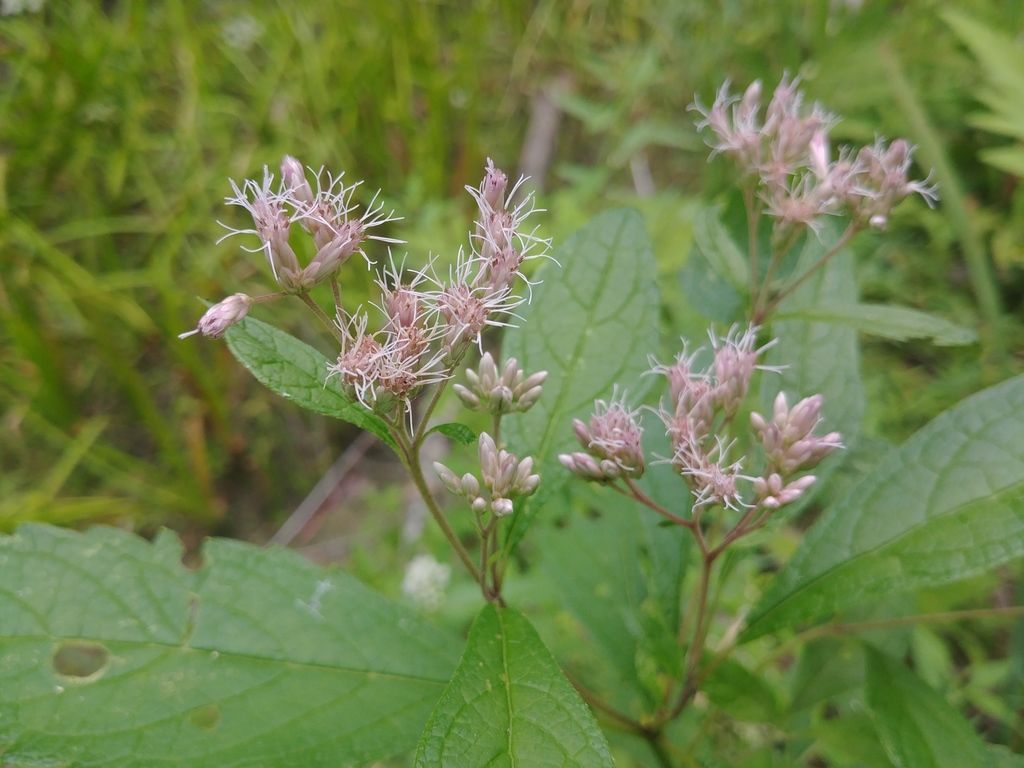
Flower profile
Spotted Joe-Pye weed
Eutrochium maculatum
Spotted Joe-Pye weed (Eutrochium maculatum) is a flowering plant in the Asteraceae family, native in the lower 48 states, blooming mostly July–September across the U.S.
Spotted Joe-Pye weed is a wildflower that USDA PLANTS lists as native in the lower 48 states. It's on our flower lists for 5 states, and across the U.S. it's most often seen in bloom in July–September.
*iNaturalist research-grade observations, as of October 17, 2026.
On our lists for: Michigan, Minnesota, New Hampshire, Vermont, Wisconsin
Quick look
Eutrochium maculatum, the spotted Joe Pye weed, is a North American species of flowering plant in the family Asteraceae. It is widespread through much of the United States and Canada. It is the only species of the genus Eutrochium found west of the Great Plains.
- It belongs to the Asteraceae family. iNaturalist
- USDA PLANTS describes it as an herb (forb) with a perennial life cycle. USDA PLANTS
- USDA PLANTS lists it as native in the lower 48 states and records it in 36 states. USDA PLANTS
- NatureServe lists it as native to Michigan, Wisconsin, Minnesota, Vermont and New Hampshire. NatureServe
- In Michigan, most iNaturalist sightings of it in flower come in July–September. iNaturalist
- In Wisconsin, most iNaturalist sightings of it in flower come in July–September. iNaturalist
- iNaturalist has 2,051 research-grade sightings of it in Michigan, ranking #77 among the 172 flowers on our Michigan list. iNaturalist
- iNaturalist has 1,870 research-grade sightings of it in Wisconsin, ranking #79 among the 161 flowers on our Wisconsin list. iNaturalist
- iNaturalist has 1,794 research-grade sightings of it in Minnesota, ranking #69 among the 152 flowers on our Minnesota list. iNaturalist
When does it bloom?
Bloom time in the 5 states whose Bloomipedia list includes it
| State | Type | Peak bloom | Sightings* |
|---|---|---|---|
| Michigan | Native | July–September | 2,051 |
| Wisconsin | Native | July–September | 1,870 |
| Minnesota | Native | July–September | 1,794 |
| Vermont | Native | July–September | 1,178 |
| New Hampshire | Native | July–September | 282 |
Conservation status
- Federal (U.S. ESA)
- Not listed No U.S. Endangered Species Act listing in the USFWS ECOS database. USFWS ECOS
- NatureServe global
- G5 Secure worldwide. NatureServe
- State rare plant lists
- Not listed Not on the official rare plant list in 5 of our 5 states.
See each state
- Michigan
- Not listed Not on Michigan endangered and threatened plants (Mich. Admin. Code R 299.1028, eff. March 20, 2023). NatureServe: SNR, not yet ranked in Michigan. R 299.1028
- Wisconsin
- Not listed Not on Wisconsin endangered and threatened species list (Wis. Admin. Code NR 27.03). NatureServe: SNR, not yet ranked in Wisconsin. NR 27.03
- Minnesota
- Not listed Not on Minnesota endangered, threatened and special concern plants (Minn. R. 6134.0300). NatureServe: SNR, not yet ranked in Minnesota. Minn. R. 6134.0300
- Vermont
- Not listed Not on Endangered and Threatened Plants of Vermont (10 V.S.A. chap. 123; list of Feb 10, 2022). NatureServe: S5, secure in Vermont. Vermont E&T list
- New Hampshire
- Not listed Not on New Hampshire Official Rare Plants List (Ncr 312, eff. Jan 1, 2020). NatureServe: SNR, not yet ranked in New Hampshire. NH Ncr 312
- Rare elsewhere
- Other states where NatureServe ranks it rare or missing: AZ (S2), GA (S2), ID (S1), MT (S1), VA (S2), WV (S2). (S1 critically imperiled, S2 imperiled, SH possibly extirpated, SX presumed extirpated.)
Checked October 17, 2026. Rankings and lists can change, so follow the links for the latest.
Can you eat it?
None of the sources we checked (NC State Extension (no edibility or poison notes on its page), USDA PLANTS) say whether it's edible or poisonous for people. NC State Extension
It isn't on the ASPCA plant list, and NC State Extension doesn't flag it for pets.
🌿 Never eat a wild plant unless you're certain of its ID; this isn't medical advice. Worried about a person? Call Poison Control at 1-800-222-1222. Worried about a pet? Call your vet.
Where does it grow?
USDA PLANTS records spotted Joe-Pye weed in 36 states.
recorded by USDA PLANTS on our state lists not recorded
See the full list of states
Arizona, Colorado, Connecticut, Georgia, Idaho, Illinois, Indiana, Iowa, Kansas, Kentucky, Maine, Maryland, Massachusetts, Michigan, Minnesota, Missouri, Montana, Nebraska, New Hampshire, New Jersey, New Mexico, New York, North Carolina, North Dakota, Ohio, Pennsylvania, Rhode Island, South Dakota, Tennessee, Utah, Vermont, Virginia, Washington, West Virginia, Wisconsin, Wyoming.
Michigan counties with USDA records: Alcona, Alger, Allegan, Alpena, Antrim, Arenac, Baraga, Barry, Bay, Benzie, Berrien, Calhoun, Cass, Charlevoix, Cheboygan, Chippewa, Clare, Clinton, Crawford, Delta, Dickinson, Emmet, Genesee, Gladwin, Gogebic, Grand Traverse, Gratiot, Hillsdale, Houghton, Huron, Ingham, Ionia, Iosco, Iron, Isabella, Jackson, Kalamazoo, Kalkaska, Kent, Keweenaw, Lake, Lapeer, Leelanau, Lenawee, Livingston, Luce, Mackinac, Macomb, Manistee, Marquette, Mecosta, Menominee, Midland, Missaukee, Monroe, Montcalm, Montmorency, Muskegon, Oakland, Oceana, Ogemaw, Ontonagon, Oscoda, Otsego, Ottawa, Presque Isle, Roscommon, Sanilac, Schoolcraft, St. Clair, St. Joseph, Tuscola, Van Buren, Washtenaw, Wayne.
Wisconsin counties with USDA records: Adams, Ashland, Barron, Bayfield, Brown, Buffalo, Burnett, Calumet, Chippewa, Clark, Columbia, Crawford, Dane, Dodge, Door, Douglas, Dunn, Eau Claire, Florence, Fond du Lac, Forest, Grant, Green, Green Lake, Iowa, Iron, Jackson, Jefferson, Kenosha, Kewaunee, La Crosse, Langlade, Lincoln, Manitowoc, Marathon, Marinette, Marquette, Menominee, Milwaukee, Monroe, Oconto, Oneida, Outagamie, Ozaukee, Pierce, Polk, Portage, Price, Racine, Richland, Rock, Rusk, Sauk, Sawyer, Shawano, Sheboygan, St. Croix, Taylor, Trempealeau, Vernon, Vilas, Walworth, Washburn, Washington, Waukesha, Waupaca, Waushara, Winnebago, Wood.
Minnesota counties with USDA records: Aitkin, Anoka, Becker, Beltrami, Benton, Big Stone, Blue Earth, Brown, Carlton, Carver, Cass, Chippewa, Chisago, Clay, Clearwater, Cook, Crow Wing, Dakota, Dodge, Fillmore, Goodhue, Hennepin, Houston, Hubbard, Itasca, Jackson, Kandiyohi, Kittson, Koochiching, Lac qui Parle, Lake, Lake of the Woods, Le Sueur, Lincoln, Lyon, Mahnomen, Marshall, Martin, Morrison, Mower, Murray, Nicollet, Nobles, Norman, Olmsted, Otter Tail, Pine, Pipestone, Polk, Pope, Ramsey, Red Lake, Redwood, Rice, Roseau, Scott, Sherburne, St. Louis, Stearns, Steele, Stevens, Swift, Todd, Traverse, Wabasha, Wadena, Waseca, Washington, Wilkin, Winona, Wright, Yellow Medicine.
Names, range and relatives
Native status by region (USDA PLANTS): Canada: Native; Lower 48 states: Native; St. Pierre and Miquelon: Native.
Other scientific names (synonyms in USDA PLANTS): Eupatoriadelphus maculatus, Eupatorium maculatum.
County records: USDA PLANTS lists it in 594 counties across 32 states; the most are in Michigan (75), Minnesota (72), Wisconsin (69).
More from the Asteraceae family (212 on Bloomipedia; most observed first): Common yarrow, Goldenrods, White snakeroot, Sunflowers, Chicory, Black-eyed Susan, Bull thistle, Common dandelion.
More Michigan flowers
Sources
- USDA, NRCS. PLANTS Database, profile EUMA9.
- iNaturalist, Eutrochium maculatum: taxonomy, research-grade observation counts and “Flowering” annotations, retrieved October 17, 2026.
- Wikipedia, Eutrochium maculatum (lead quoted under CC BY-SA 4.0).
- State rare and invasive plant lists (10):
Show all 10 state lists
- Michigan: Michigan endangered and threatened plants (Mich. Admin. Code R 299.1028, eff. March 20, 2023).
- Michigan: Michigan prohibited and restricted species (NREPA Part 413 and the 2026 Invasive Species Order), as listed by Michigan's Invasive Species Program.
- Wisconsin: Wisconsin endangered and threatened species list (Wis. Admin. Code NR 27.03).
- Wisconsin: Wisconsin invasive species rule (Wis. Admin. Code NR 40.04 prohibited, NR 40.05 restricted).
- Minnesota: Minnesota endangered, threatened and special concern plants (Minn. R. 6134.0300).
- Minnesota: Minnesota Noxious Weed List (Minn. Stat. § 18.79; Minnesota Department of Agriculture, updated January 2026).
- Vermont: Endangered and Threatened Plants of Vermont (10 V.S.A. chap. 123; list of Feb 10, 2022).
- Vermont: Vermont Quarantine List, Regulated Introduced Plant Species Rule (eff. June 16, 2026).
- New Hampshire: New Hampshire Official Rare Plants List (Ncr 312, eff. Jan 1, 2020).
- New Hampshire: NH Prohibited Invasive Species List (Agr 3800, Table 3800.1).
- USFWS, ECOS species database (ESA listing check), October 17, 2026.
- NatureServe Explorer, Eutrochium maculatum (global and state ranks).
- Edibility and toxicity: NC State Extension.
- Photo: Laura J. Costello via iNaturalist · CC BY 4.0 · resized.