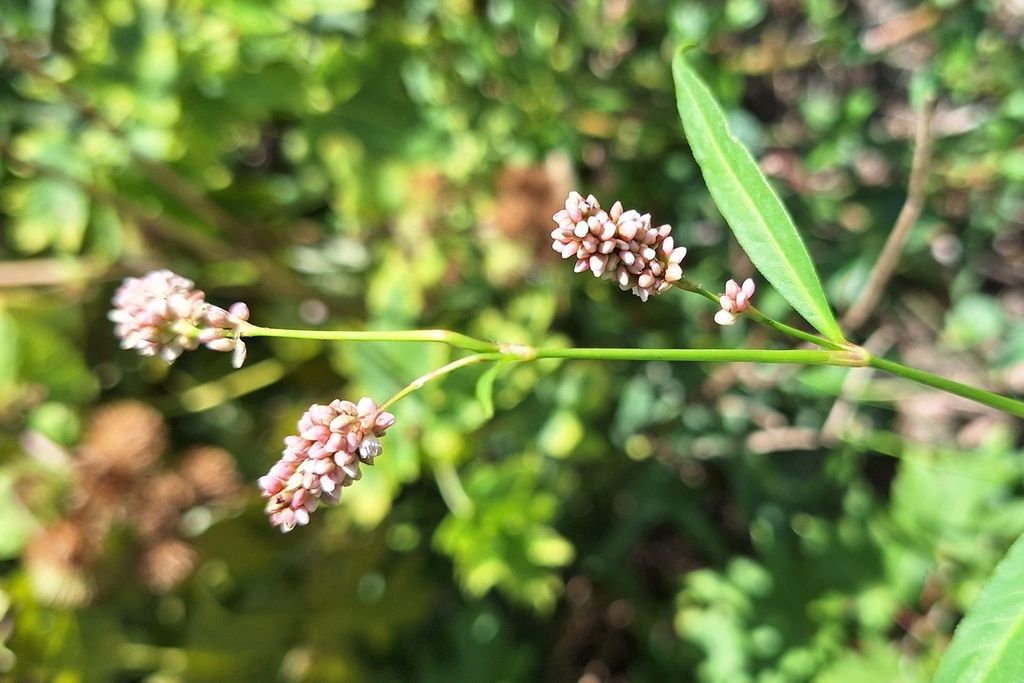
Flower profile
Spotted lady's thumb
Persicaria maculosa
Spotted lady's thumb (Persicaria maculosa) is a flowering plant in the Polygonaceae family, introduced in the lower 48 states, blooming mostly July–October across the U.S.
Spotted lady's thumb is a wildflower that USDA PLANTS lists as introduced in the lower 48 states.
*iNaturalist research-grade observations, as of October 17, 2026.
On our lists for: Iowa
Quick look
Persicaria maculosa is an annual plant in the buckwheat family, Polygonaceae. Common names include lady's thumb, spotted lady's thumb, Jesusplant, and redshank. It is widespread across Eurasia from Iceland south to Portugal and east to Japan.
- It belongs to the Polygonaceae family. iNaturalist
- USDA PLANTS describes it as an herb (forb) with a annual, perennial life cycle. USDA PLANTS
- USDA PLANTS lists it as introduced in the lower 48 states and records it in 49 states. USDA PLANTS
- NatureServe lists it as not native to Iowa. NatureServe
- USDA PLANTS lists its flower color as red. USDA PLANTS
- USDA PLANTS gives its bloom period as spring. USDA PLANTS
- USDA PLANTS lists a mature height of about 3.2 ft. USDA PLANTS
- iNaturalist has 293 research-grade sightings of it in Iowa, ranking #88 among the 147 flowers on our Iowa list. iNaturalist
When does it bloom?
There are only a handful of Iowa flowering records, so this chart uses records from across the U.S.
Conservation status
- Federal (U.S. ESA)
- Not listed Not listed under the Endangered Species Act. USFWS ECOS does track it with the label “Resolved Taxon,” which is informal and gives no legal protection. USFWS ECOS
- NatureServe global
- G4 Apparently secure worldwide. NatureServe
- Iowa
- Not listed Not on Iowa endangered, threatened and special concern plants (Iowa Admin. Code r. 571-77.3). NatureServe: SNA, not applicable (usually because it isn't native there) in Iowa. IAC 571-77.3
- Rare elsewhere
- No other U.S. state ranks it S1, S2, SH or SX.
Checked October 17, 2026. Rankings and lists can change, so follow the links for the latest.
Can you eat it?
None of the sources we checked (NC State Extension (no page for this plant), USDA PLANTS) say whether it's edible or poisonous for people.
It isn't on the ASPCA plant list.
🌿 Never eat a wild plant unless you're certain of its ID; this isn't medical advice. Worried about a person? Call Poison Control at 1-800-222-1222. Worried about a pet? Call your vet.
Where does it grow?
USDA PLANTS records spotted lady's thumb in 49 states plus Washington, D.C.
recorded by USDA PLANTS on our state lists not recorded
See the full list of states
Alabama, Alaska, Arizona, Arkansas, California, Colorado, Connecticut, Delaware, Florida, Georgia, Idaho, Illinois, Indiana, Iowa, Kansas, Kentucky, Louisiana, Maine, Maryland, Massachusetts, Michigan, Minnesota, Mississippi, Missouri, Montana, Nebraska, Nevada, New Hampshire, New Jersey, New Mexico, New York, North Carolina, North Dakota, Ohio, Oklahoma, Oregon, Pennsylvania, Rhode Island, South Carolina, South Dakota, Tennessee, Texas, Utah, Vermont, Virginia, Washington, West Virginia, Wisconsin, Wyoming; District of Columbia.
Iowa counties with USDA records: Adair, Adams, Allamakee, Audubon, Cass, Cherokee, Crawford, Fremont, Greene, Guthrie, Harrison, Ida, Madison, Mills, Monona, Montgomery, O'Brien, Osceola, Page, Plymouth, Pottawattamie, Ringgold, Shelby, Sioux, Taylor, Union, Webster, Winneshiek, Woodbury.
Growing conditions
USDA PLANTS gives Spotted lady's thumb a high shade tolerance, medium drought tolerance and medium moisture use. It is rated for soil pH 4.0 to 8.5 and winter lows down to 32 °F.
- Shade tolerance
- High
- Drought tolerance
- Medium
- Moisture use
- Medium
- Soil textures it is adapted to
- coarse, medium, fine
- Soil pH range
- 4.0 to 8.5
- Minimum temperature tolerated
- 32 °F
- Frost-free days needed (minimum)
- 110
- Annual precipitation range
- 14 to 60 inches
- Minimum root depth
- 14 inches
- Salinity tolerance
- Low
- Fertility requirement
- Low
- Growth rate
- Rapid
- Lifespan
- Short
- Active growth period
- Spring
- Fruit or seed
- Black · Spring to Fall
- Can be propagated by
- seed
- Commercial availability
- Routinely Available
From the USDA PLANTS characteristics data for POPE3. USDA ratings are general guidance for the species, not a guarantee for your garden.
Names, range and relatives
Native status by region (USDA PLANTS): Alaska: Introduced; Canada: Introduced; Greenland: Introduced; Lower 48 states: Introduced; St. Pierre and Miquelon: Introduced.
Other scientific names (synonyms in USDA PLANTS): Persicaria maculata, Persicaria persicaria, Persicaria puritanorum, Persicaria ruderalis, Persicaria vulgaris, Polygonum dubium, Polygonum fusiforme, Polygonum puritanorum.
County records: USDA PLANTS lists it in 1447 counties across 49 states; the most are in Virginia (91), Illinois (88), North Carolina (88).
Other Persicaria on Bloomipedia (5): American jumpseed, Low smartweed, Mile-a-minute weed, Water smartweed, Pink knotweed.
More from the Polygonaceae family (21 on Bloomipedia; most observed first): California buckwheat, Japanese knotweed, Sulfur buckwheat, Desert trumpet, American bistort, Cushion buckwheat, Devil's spineflower, Parsnipflower buckwheat.
More Iowa flowers
Sources
- USDA, NRCS. PLANTS Database, profile POPE3.
- iNaturalist, Persicaria maculosa: taxonomy, research-grade observation counts and “Flowering” annotations, retrieved October 17, 2026.
- Wikipedia, Persicaria maculosa (lead quoted under CC BY-SA 4.0).
- Iowa: Iowa endangered, threatened and special concern plants (Iowa Admin. Code r. 571-77.3).
- Iowa: Iowa noxious weeds (Iowa Code § 317.1A).
- USFWS, ECOS species database (ESA listing check), October 17, 2026.
- NatureServe Explorer, Persicaria maculosa (global and state ranks).
- Edibility and toxicity: no source found (marked "not well documented").
- Photo: Barrett Coller Jr. via iNaturalist · CC BY 4.0 · resized.