Flower profile
Cutleaf evening primrose
Oenothera laciniata
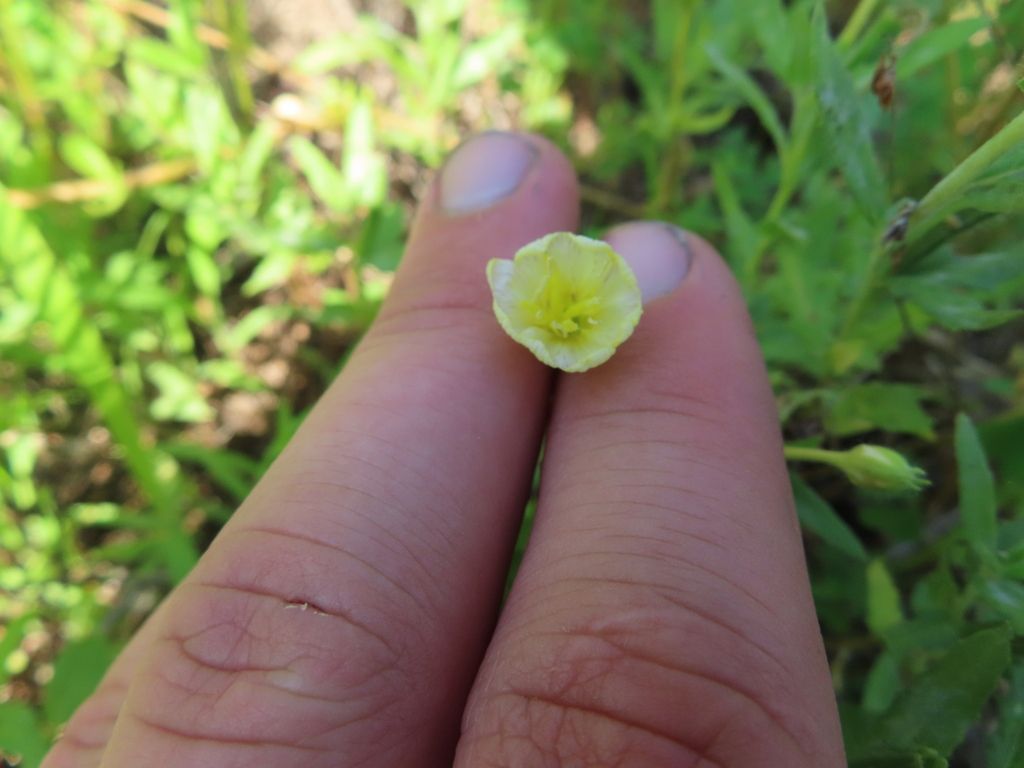
Cutleaf evening primrose is a wildflower in the Onagraceae family.12 USDA PLANTS lists it as native in the lower 48 states.2 It is often found in almost all of North America east of the Rocky Mountains and some areas west of the Rockies. Found on disturbed ground, fields, and fencerows. Grows in well drained sandy and limestone soils.3 Across the U.S., flowering sightings are most often in March–May.1
Identification
Cutleaf evening primrose is described as herbaceous, with annual, perennial.2
The Lady Bird Johnson Wildflower Center describes plants up to about 2 feet tall.3
The Lady Bird Johnson Wildflower Center lists bloom colors as white, pink and yellow.3
When it blooms
In Mississippi, most flowering sightings come in March–May.1
The Lady Bird Johnson Wildflower Center lists March–October3. iNaturalist flowering sightings across the U.S. are most often in March–May1.
Where it grows
USDA PLANTS records it in 39 states, plus Washington, D.C.2 It is listed as native in the lower 48 states.2 Habitat notes from the same record include almost all of North America east of the Rocky Mountains and some areas west of the Rockies. Found on disturbed ground, fields, and fencerows. Grows in well drained sandy and limestone soils.3
See the full state list
- Mississippi
- Alabama
- Arkansas
- California
- Connecticut
- Delaware
- Florida
- Georgia
- Hawaii
- Illinois
- Indiana
- Iowa
- Kansas
- Kentucky
- Louisiana
- Maine
- Maryland
- Massachusetts
- Michigan
- Minnesota
- Missouri
- Nebraska
- New Jersey
- New Mexico
- New York
- North Carolina
- North Dakota
- Ohio
- Oklahoma
- Pennsylvania
- South Carolina
- South Dakota
- Tennessee
- Texas
- Vermont
- Virginia
- West Virginia
- Wisconsin
- Wyoming
- District of Columbia
Growing and habitat
The Lady Bird Johnson record rates its needs as light: part shade.3
Growing note from that record: “Leaves are narrow with toothed to deeply lobed margins. They have a distinctive white midvein. The pale yellow flowers have pinkish sepals and open in the evening withering the next morning. The fruit is an elongated, curved pod. Seed in…”3
Wildflower Center ratings are general guidance for the species, not a guarantee for your garden.
Conservation
Other states where NatureServe ranks it rare or missing: NY (S1), WY (S1). (S1 critically imperiled, S2 imperiled, SH possibly extirpated, SX presumed extirpated.)4
Related plants
Sources and review date
Facts on this page are drawn from the sources below. Numbers in the text point here. Sources used for this page were retrieved between October 17, 2026 and November 16, 2026.
- iNaturalist (taxonomy, research-grade observation counts and “Flowering” annotations, retrieved October 17, 2026).
- USDA, NRCS. PLANTS Database (profile OELA).
- Lady Bird Johnson Wildflower Center, Native Plant Information Network (record OELA, retrieved November 16, 2026).
- NatureServe Explorer (global and state ranks for Oenothera laciniata).
- Photo: Eric Schmidt via iNaturalist · CC BY 4.0 · resized.