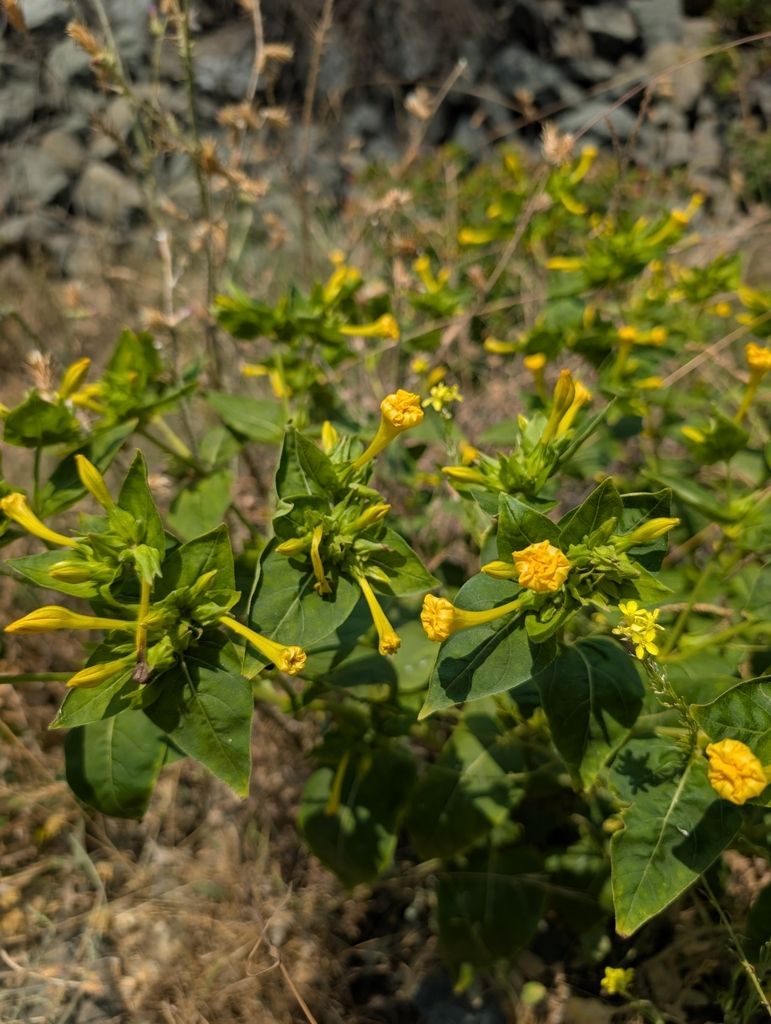
Garden flower
Marvel of Peru
Mirabilis jalapa
Marvel of Peru (Mirabilis jalapa) is a low shrub in the Nyctaginaceae family, introduced in the lower 48 states, blooming mostly May–October across the U.S.
Marvel of Peru is a popular garden flower. It's grown in Connecticut gardens, so wild records are few.
*iNaturalist research-grade observations, as of October 17, 2026. Planted garden flowers are mostly excluded from research grade.
On our lists for: Connecticut
Quick look
Mirabilis jalapa, the marvel of Peru or four o'clock flower, is the most commonly grown ornamental species of Mirabilis plant, and is available in a range of colors. Mirabilis in Latin means wonderful and Jalapa is the state capital of Veracruz in Mexico. Mirabilis jalapa is believed to have been cultivated by the Aztecs for medicinal and ornamental purposes.
- It belongs to the Nyctaginaceae family. iNaturalist
- USDA PLANTS describes it as an herb (forb) / a subshrub with a perennial life cycle. USDA PLANTS
- USDA PLANTS lists it as introduced in the lower 48 states and records it in 28 states. USDA PLANTS
- NatureServe lists it as not native to Connecticut. NatureServe
- iNaturalist has 21 research-grade sightings of it in Connecticut, ranking #119 among the 179 flowers on our Connecticut list. iNaturalist
When does it bloom?
There are only a handful of Connecticut flowering records (garden plants are mostly left out of research-grade records), so this chart uses records from across the U.S.
Conservation status
- Federal (U.S. ESA)
- Not listed No U.S. Endangered Species Act listing in the USFWS ECOS database. USFWS ECOS
- NatureServe global
- GNR Not yet ranked worldwide. NatureServe
- Connecticut
- Not listed Not on Connecticut Endangered, Threatened and Special Concern Plants (RCSA 26-306; 2015 list). NatureServe: SNA, not applicable (usually because it isn't native there) in Connecticut. CT E/T/SC list
- Rare elsewhere
- No other U.S. state ranks it S1, S2, SH or SX.
Checked October 17, 2026. Rankings and lists can change, so follow the links for the latest.
Can you eat it?
NC State Extension lists it as poisonous to humans (severity: low). Poisonous parts: roots, seeds. Symptoms they list: “Stomach pain, nausea, vomiting, diarrhea; handling of the roots may cause dermatitis” NC State Extension
It isn't on the ASPCA plant list, and NC State Extension doesn't flag it for pets.
🌿 Never eat a wild plant unless you're certain of its ID; this isn't medical advice. Worried about a person? Call Poison Control at 1-800-222-1222. Worried about a pet? Call your vet.
Where does it grow?
USDA PLANTS records marvel of Peru in 28 states plus Washington, D.C.
recorded by USDA PLANTS on our state lists not recorded
See the full list of states
Alabama, Arizona, Arkansas, California, Connecticut, Florida, Georgia, Hawaii, Illinois, Indiana, Kentucky, Louisiana, Maryland, Mississippi, Nevada, New Jersey, New York, North Carolina, Ohio, Oklahoma, Oregon, Pennsylvania, Rhode Island, South Carolina, Texas, Vermont, Virginia, Washington; District of Columbia.
Names, range and relatives
Native status by region (USDA PLANTS): Hawaii: Introduced; Lower 48 states: Introduced; Pacific Basin (excluding Hawaii): Introduced; Puerto Rico: Introduced; U.S. Virgin Islands: Introduced.
Other scientific names (synonyms in USDA PLANTS): Mirabilis lindheimeri.
County records: USDA PLANTS lists it in 153 counties across 24 states; the most are in Louisiana (35), Texas (19), Florida (15).
Other Mirabilis on Bloomipedia (3): Wishbone bush, Wild Four o'Clock, Colorado Four o'Clock.
More from the Nyctaginaceae family (9 on Bloomipedia; most observed first): Trailing windmills, Scarlet spiderling, Great basin sand verbena, Snowball sand verbena, Purple sand verbena, Bougainvillea.
More Connecticut flowers
Sources
- USDA, NRCS. PLANTS Database, profile MIJA.
- iNaturalist, Mirabilis jalapa: taxonomy, research-grade observation counts and “Flowering” annotations, retrieved October 17, 2026.
- Wikipedia, Mirabilis jalapa (lead quoted under CC BY-SA 4.0).
- Conn. Gen. Stat. § 3-108a: Connecticut children's state flower.
- Connecticut: Connecticut Endangered, Threatened and Special Concern Plants (RCSA 26-306; 2015 list).
- Connecticut: Connecticut prohibited invasive plants (Conn. Gen. Stat. § 22a-381d).
- USFWS, ECOS species database (ESA listing check), October 17, 2026.
- NatureServe Explorer, Mirabilis jalapa (global and state ranks).
- Edibility and toxicity: NC State Extension.
- Photo: sdash via iNaturalist · CC BY 4.0 · resized.