Flower profile
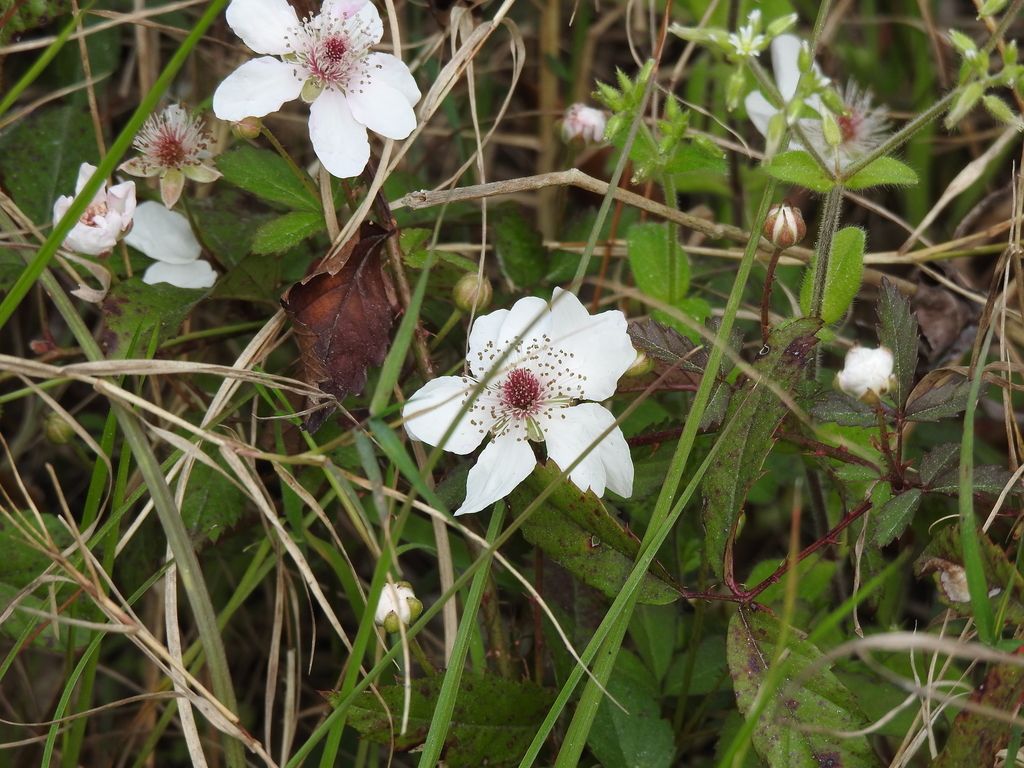
Southern dewberry
Rubus trivialis
Southern dewberry is a flowering plant that USDA PLANTS lists as native in the lower 48 states. It's on our flower lists for 7 states, and across the U.S. it's most often seen in bloom in February–April.
*iNaturalist research-grade observations, as of October 17, 2026.
On our lists for: Alabama, Florida, Georgia, Louisiana, Mississippi, South Carolina, Texas
Quick look
Rubus trivialis, commonly known as southern dewberry, is a species of flowering plant in the rose family (Rosaceae). It is distinguished from northern dewberry (R. flagellaris) by its hispid stems. It is a perennial herb and blooms from March to April.
- It belongs to the Rosaceae family. iNaturalist
- USDA PLANTS describes it as a subshrub / a vine with a perennial life cycle. USDA PLANTS
- USDA PLANTS lists it as native in the lower 48 states and records it in 20 states. USDA PLANTS
- In Texas, most iNaturalist sightings of it in flower come in February–April. iNaturalist
- In Florida, most iNaturalist sightings of it in flower come in February–March. iNaturalist
- iNaturalist has 15,412 research-grade sightings of it in Texas, ranking #27 among the 109 flowers on our Texas list. iNaturalist
- iNaturalist has 3,490 research-grade sightings of it in Florida, ranking #80 among the 110 flowers on our Florida list. iNaturalist
- iNaturalist has 2,094 research-grade sightings of it in Louisiana, ranking #5 among the 109 flowers on our Louisiana list. iNaturalist
Southern dewberry gift ideas
Handmade southern dewberry gifts from independent makers.
🌱 Sample spot. Handmade gift picks from independent shops will appear here once our shop partnership is approved. These cards are placeholders, not real products.
-
Placeholder
Southern dewberry art print
-
Placeholder
Southern dewberry greeting card
-
Placeholder
Southern dewberry mug
-
Placeholder
Southern dewberry earrings
-
Placeholder
Southern dewberry embroidery pattern
-
Placeholder
Southern dewberry sticker
When does it bloom?
Bloom time in each of our 7 states
| State | Type | Peak bloom | Sightings* |
|---|---|---|---|
| Texas | Native | February–April | 15,412 |
| Florida | Native | February–March | 3,490 |
| Louisiana | Native | February–April | 2,094 |
| Alabama | Native | February–April | 1,744 |
| Georgia | Native | February–April | 1,512 |
| South Carolina | Native | February–April | 1,240 |
| Mississippi | Native | February–April | 767 |
Conservation status
- Federal (U.S. ESA)
- Not listed Not listed under the Endangered Species Act. USFWS ECOS does track it with the label “Resolved Taxon,” which is informal and gives no legal protection. USFWS ECOS
- NatureServe global
- G5 Secure worldwide. NatureServe
- Texas
- Not listed Not on Texas endangered and threatened plants (31 Tex. Admin. Code § 69.8), as listed by Texas Parks and Wildlife. NatureServe: SNR, not yet ranked in Texas. 31 TAC 69.8
- Florida
- Not listed Not on Florida Regulated Plant Index (Fla. Admin. Code 5B-40.0055). NatureServe: SNR, not yet ranked in Florida. FAC 5B-40.0055
- Louisiana
- No list Louisiana has no state list of endangered or threatened plants separate from the federal list, so we show federal status and NatureServe's Louisiana ranks. NatureServe: SNR, not yet ranked in Louisiana.
- Alabama
- No list Alabama has no state law listing endangered or threatened plants, so we show NatureServe's Alabama ranks instead. NatureServe: SNR, not yet ranked in Alabama.
- Georgia
- Not listed Not on Georgia protected plants (Ga. Comp. R. & Regs. 391-4-10-.09; a 2026 update is proposed). NatureServe: SNR, not yet ranked in Georgia. Ga. R. 391-4-10-.09
- South Carolina
- No list South Carolina has no state law listing endangered or threatened plants, so we show NatureServe's South Carolina ranks instead. NatureServe: SNR, not yet ranked in South Carolina.
- Mississippi
- No list Mississippi has no state law listing endangered or threatened plants, so we show NatureServe's Mississippi ranks instead. NatureServe: SNR, not yet ranked in Mississippi.
- Rare elsewhere
- No other U.S. state ranks it S1, S2, SH or SX.
Checked October 17, 2026. Rankings and lists can change, so follow the links for the latest.
Can you eat it?
NC State Extension notes: “Can be eaten raw or cooked and is typically used in jams and preserves. The fruit is large, juicy, and sweet.” NC State Extension
It isn't on the ASPCA plant list, and NC State Extension doesn't flag it for pets. For context only: ASPCA lists a related species, Rubus pedatus (“Creeping Rubus”), as non-toxic to dogs and cats. That doesn't tell us about this species, so keep pets away to be safe. ASPCA
🌿 Never eat a wild plant unless you're certain of its ID; this isn't medical advice. Worried about a person? Call Poison Control at 1-800-222-1222. Worried about a pet? Call your vet.
Where does it grow?
USDA PLANTS records Southern dewberry in 20 states.
recorded by USDA PLANTS on our state lists not recorded
See the full list of states
Alabama, Arkansas, Florida, Georgia, Illinois, Kansas, Kentucky, Louisiana, Maryland, Mississippi, Missouri, North Carolina, Ohio, Oklahoma, Pennsylvania, South Carolina, Tennessee, Texas, Virginia, West Virginia.
Texas counties with USDA records: Anderson, Aransas, Bastrop, Bell, Bexar, Blanco, Brazoria, Brazos, Burleson, Burnet, Caldwell, Calhoun, Cameron, Cherokee, Cooke, Dallas, Delta, Denton, Fannin, Fayette, Fort Bend, Freestone, Galveston, Gillespie, Goliad, Gonzales, Grayson, Gregg, Hardin, Harris, Hays, Houston, Hunt, Johnson, Kaufman, Kendall, Kerr, Kimble, Limestone, Llano, Mason, McLennan, Milam, Montgomery, Nacogdoches, Navarro, Polk, Robertson, Rusk, San Patricio, San Saba, Smith, Tarrant, Travis, Trinity, Val Verde, Washington, Webb, Williamson, Wood, Zavala.
Florida counties with USDA records: Alachua, Bay, Brevard, Charlotte, Citrus, Collier, DeSoto, Duval, Escambia, Flagler, Franklin, Gadsden, Gilchrist, Gulf, Hendry, Hernando, Highlands, Hillsborough, Holmes, Jackson, Jefferson, Lafayette, Lake, Lee, Leon, Levy, Manatee, Marion, Martin, Okaloosa, Orange, Palm Beach, Pasco, Pinellas, Polk, Putnam, Sarasota, Seminole, St. Johns, St. Lucie, Sumter, Taylor, Volusia, Wakulla, Walton.
Louisiana counties with USDA records: Allen, Assumption, Avoyelles, Beauregard, Bienville, Bossier, Caddo, Calcasieu, Caldwell, Cameron, Catahoula, Claiborne, Concordia, De Soto, East Baton Rouge, East Carroll, East Feliciana, Evangeline, Franklin, Grant, Iberia, Iberville, Jackson, Jefferson, Jefferson Davis, LaSalle, Lafayette, Lafourche, Lincoln, Livingston, Madison, Morehouse, Natchitoches, Orleans, Ouachita, Plaquemines, Pointe Coupee, Rapides, Red River, Richland, Sabine, St. Bernard, St. Charles, St. Helena, St. James, St. John the Baptist, St. Landry, St. Martin, St. Tammany, Tangipahoa, Tensas, Terrebonne, Union, Vermilion, Vernon, Washington, West Carroll, West Feliciana, Winn.
More Texas flowers
Sources
- USDA, NRCS. PLANTS Database, profile RUTR.
- iNaturalist, Rubus trivialis: taxonomy, research-grade observation counts and “Flowering” annotations, retrieved October 17, 2026.
- Wikipedia, Rubus trivialis (lead quoted under CC BY-SA 4.0).
- Texas: Texas endangered and threatened plants (31 Tex. Admin. Code § 69.8), as listed by Texas Parks and Wildlife.
- Texas: Texas noxious and invasive plant list (4 Tex. Admin. Code § 19.300(a)).
- Florida: Florida Regulated Plant Index (Fla. Admin. Code 5B-40.0055).
- Florida: Florida Noxious Weed List (Fla. Admin. Code 5B-57.007).
- Alabama: Alabama noxious weeds (Ala. Admin. Code r. 80-10-14-.04).
- Georgia: Georgia protected plants (Ga. Comp. R. & Regs. 391-4-10-.09; a 2026 update is proposed).
- South Carolina: South Carolina State Plant Pest List, plants (S.C. Code Regs. 27-135; Clemson Dept. of Plant Industry).
- Mississippi: Mississippi Noxious Weed List (2 Miss. Code R. 1-3-01-136.01).
- USFWS, ECOS species database (ESA listing check), October 17, 2026.
- NatureServe Explorer, Rubus trivialis (global and state ranks).
- Edibility and toxicity: NC State Extension; ASPCA.
- Photo: sudomir via iNaturalist · CC BY 4.0 · resized.