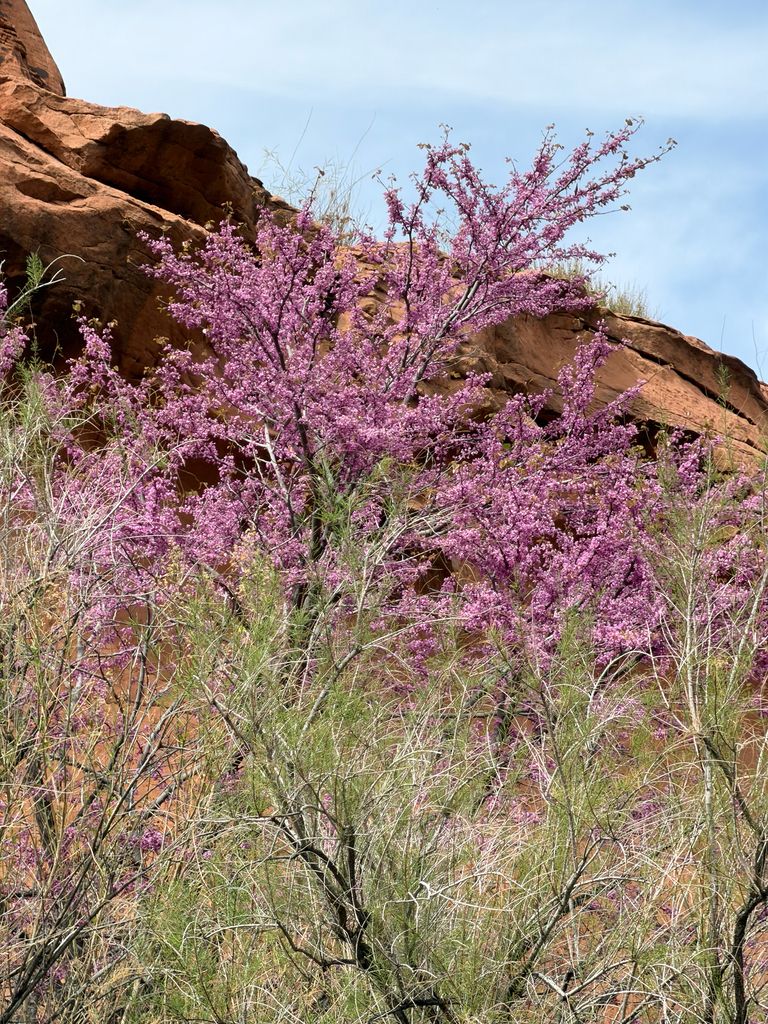
Flowering shrub
Western redbud
Cercis occidentalis
Western redbud (Cercis occidentalis) is a shrub in the Fabaceae family, native in the lower 48 states, blooming mostly March–April across the U.S.
Western redbud is a popular flowering shrub. It's on our flower lists for 14 states, and across the U.S. it's most often seen in bloom in March–April.
*iNaturalist research-grade observations, as of October 23, 2026. Our state lists also include states where people grow it in gardens, so they can outnumber USDA's wild-plant records. Planted garden shrubs are mostly excluded from research grade.
On our lists for: Arizona, California, Colorado, Idaho, Maryland, Missouri, Nevada, New Mexico, New York, Oregon, Texas, Utah, Virginia, Washington
Quick look
Cercis occidentalis, the western redbud or California redbud, is a small tree or shrub in the legume family, Fabaceae. It is found primarily in Oregon and Northern California, with other redbuds of Utah and Arizona typically being the related species Cercis orbiculata.
- It belongs to the Fabaceae family. iNaturalist
- USDA PLANTS describes it as a shrub / a tree with a perennial life cycle. USDA PLANTS
- USDA PLANTS lists it as native in the lower 48 states and records it in 2 states. USDA PLANTS
- In California, most iNaturalist sightings of it in flower come in March–April. iNaturalist
- USDA PLANTS lists its flower color as red. USDA PLANTS
- USDA PLANTS gives its bloom period as early spring. USDA PLANTS
- USDA PLANTS lists a mature height of about 12 ft. USDA PLANTS
- iNaturalist has 4,211 research-grade sightings of it in California, ranking #104 among the 178 flowers on our California list. iNaturalist
- iNaturalist has 2 research-grade sightings of it in Texas, ranking #134 among the 169 flowers on our Texas list. iNaturalist
- iNaturalist has 1 research-grade sightings of it in Arizona, ranking #111 among the 132 flowers on our Arizona list. iNaturalist
When does it bloom?
Bloom time in the 14 states whose Bloomipedia list includes it
| State | Type | Peak bloom | Sightings* |
|---|---|---|---|
| California | 🌷 Garden | March–April | 4,211 |
| Texas | 🌷 Garden | no flowering records | 2 |
| Arizona | 🌷 Garden | no flowering records | 1 |
| Nevada | 🌷 Garden | few records (1) | 1 |
| Oregon | 🌷 Garden | no flowering records | 1 |
| Colorado | 🌷 Garden | no flowering records | 0 |
| Idaho | 🌷 Garden | no flowering records | 0 |
| Maryland | 🌷 Garden | no flowering records | 0 |
| Missouri | 🌷 Garden | no flowering records | 0 |
| New Mexico | 🌷 Garden | no flowering records | 0 |
| New York | 🌷 Garden | no flowering records | 0 |
| Utah | 🌷 Garden | no flowering records | 0 |
| Virginia | 🌷 Garden | no flowering records | 0 |
| Washington | 🌷 Garden | no flowering records | 0 |
Conservation status
- Federal (U.S. ESA)
- Not listed No U.S. Endangered Species Act listing in the USFWS ECOS database. USFWS ECOS
- NatureServe global
- GNR Not yet ranked worldwide. NatureServe
- State rare plant lists
- Not listed Not on the official rare plant list in 10 of our 14 states.
See each state
- California
- Not listed Not on California state-listed endangered, threatened and rare plants (14 CCR § 670.2), per CDFW's CNDDB list (July 2026). NatureServe: SNR, not yet ranked in California. CNDDB listed plants (July 2026)
- Texas
- Not listed Not on Texas endangered and threatened plants (31 Tex. Admin. Code § 69.8), as listed by Texas Parks and Wildlife. NatureServe has no Texas rank for it. 31 TAC 69.8
- Arizona
- Not listed Not on Arizona Native Plant Law protected plants (Ariz. Admin. Code R3-3 Art. 11, App. A, eff. Feb. 2, 2025). NatureServe has no Arizona rank for it. AAC R3-3 App. A
- Nevada
- Not listed Not on Nevada fully protected plants, critically endangered (NAC 527.010). NatureServe has no Nevada rank for it. NAC 527.010
- Oregon
- Not listed Not on Oregon endangered and threatened plants (OAR 603-073-0070). NatureServe: SNR, not yet ranked in Oregon. OAR 603-073-0070
- Maryland
- Not listed Not on Maryland threatened and endangered plants (COMAR 08.03.08.05, .06 and .08). NatureServe has no Maryland rank for it. COMAR 08.03.08
- Missouri
- Not listed Not on Missouri Wildlife Code endangered species (3 CSR 10-4.111), plants. NatureServe has no Missouri rank for it. 3 CSR 10-4.111
- New Mexico
- Not listed Not on New Mexico state endangered plant species (19.21.2.9 NMAC). NatureServe has no New Mexico rank for it. 19.21.2.9 NMAC
- New York
- Not listed Not on New York protected native plants (6 NYCRR § 193.3). NatureServe has no New York rank for it. 6 NYCRR § 193.3
- Virginia
- Not listed Not on Virginia endangered and threatened plant and insect species (2VAC5-320-10). NatureServe has no Virginia rank for it. 2VAC5-320-10
- Colorado
- No list Colorado has no state law listing endangered or threatened plants, so we show NatureServe's Colorado ranks instead. NatureServe has no Colorado rank for it.
- Idaho
- No list Idaho has no state law listing endangered or threatened plants, so we show NatureServe's Idaho ranks instead. NatureServe has no Idaho rank for it.
- Utah
- No list Utah has no state law listing endangered or threatened plants, so we show NatureServe's Utah ranks instead. NatureServe has no Utah rank for it.
- Washington
- No list Washington has no state law listing endangered or threatened plants (the Washington Natural Heritage Program's rare plant list isn't regulatory), so we show NatureServe's Washington ranks instead. NatureServe has no Washington rank for it.
- Rare elsewhere
- No other U.S. state ranks it S1, S2, SH or SX.
Checked October 23, 2026. Rankings and lists can change, so follow the links for the latest.
Can you eat it?
NC State Extension notes: “The flowers are fried in Mexico. The flowers are acid and are sometimes pickled for salads. The nectar is of some value as a source of honey.” NC State Extension
It isn't on the ASPCA plant list, and NC State Extension doesn't flag it for pets.
🌿 Never eat a wild plant unless you're certain of its ID; this isn't medical advice. Worried about a person? Call Poison Control at 1-800-222-1222. Worried about a pet? Call your vet.
Where does it grow?
USDA PLANTS records Western redbud in 2 states.
recorded by USDA PLANTS on our state lists not recorded
See the full list of states
Oklahoma, Texas.
Texas counties with USDA records: Bandera, Bell, Bexar, Blanco, Bosque, Brown, Coke, Coleman, Comal, Concho, Cooke, Coryell, Dallas, Dawson, Eastland, Edwards, Foard, Gillespie, Grayson, Hale, Hays, Kendall, Kerr, Kimble, Kinney, Lampasas, Llano, McCulloch, McLennan, Medina, Menard, Mills, Mitchell, Nolan, Parker, Real, San Saba, Schleicher, Somervell, Stephens, Sutton, Tarrant, Taylor, Tom Green, Travis, Uvalde, Val Verde, Wichita, Williamson, Wise.
Growing conditions
USDA PLANTS gives Western redbud a low shade tolerance, high drought tolerance and low moisture use. It is rated for soil pH 6.0 to 8.0 and winter lows down to -8 °F.
- Shade tolerance
- Low
- Drought tolerance
- High
- Moisture use
- Low
- Soil textures it is adapted to
- medium, fine
- Soil pH range
- 6.0 to 8.0
- Minimum temperature tolerated
- -8 °F
- Frost-free days needed (minimum)
- 180
- Annual precipitation range
- 16 to 80 inches
- Minimum root depth
- 20 inches
- Salinity tolerance
- Low
- Fertility requirement
- Low
- Growth rate
- Rapid
- Lifespan
- Short
- Active growth period
- Spring
- Fruit or seed
- Brown · Summer to Fall
- Can be propagated by
- bare root, container, cuttings, seed
- Commercial availability
- Routinely Available
From the USDA PLANTS characteristics data for CECAT. USDA ratings are general guidance for the species, not a guarantee for your garden.
Names, range and relatives
County records: USDA PLANTS lists it in 50 counties across 1 states; the most are in Texas (50).
Other Cercis on Bloomipedia (1): Eastern redbud.
More from the Fabaceae family (114 on Bloomipedia; most observed first): Lupines, White clover, Red clover, Purple crownvetch, Bird's-foot trefoil, Partridge pea, White sweetclover, Common vetch.
More California flowers
Sources
- USDA, NRCS. PLANTS Database, profile CECAT.
- iNaturalist, Cercis occidentalis: taxonomy, research-grade observation counts and “Flowering” annotations, retrieved October 23, 2026.
- Wikipedia, Cercis occidentalis (lead quoted under CC BY-SA 4.0).
- State rare and invasive plant lists (24):
Show all 24 state lists
- California: California state-listed endangered, threatened and rare plants (14 CCR § 670.2), per CDFW's CNDDB list (July 2026).
- California: California noxious weed species (3 CCR § 4500).
- Texas: Texas endangered and threatened plants (31 Tex. Admin. Code § 69.8), as listed by Texas Parks and Wildlife.
- Texas: Texas noxious and invasive plant list (4 Tex. Admin. Code § 19.300(a)).
- Arizona: Arizona Native Plant Law protected plants (Ariz. Admin. Code R3-3 Art. 11, App. A, eff. Feb. 2, 2025).
- Arizona: Arizona prohibited noxious weeds (Ariz. Admin. Code R3-4-245).
- Nevada: Nevada fully protected plants, critically endangered (NAC 527.010).
- Nevada: Nevada noxious weeds (NAC 555.010).
- Oregon: Oregon endangered and threatened plants (OAR 603-073-0070).
- Oregon: Oregon noxious weed quarantine, A and B weeds (OAR 603-052-1200).
- Colorado: Colorado noxious weed lists A, B and C (8 CCR 1206-2, eff. May 15, 2025).
- Idaho: Idaho noxious weeds (IDAPA 02.06.09, Section 220).
- Maryland: Maryland threatened and endangered plants (COMAR 08.03.08.05, .06 and .08).
- Maryland: Maryland Prohibited Invasive Plant List (COMAR 15.06.04.06; MDA, updated July 2026).
- Missouri: Missouri Wildlife Code endangered species (3 CSR 10-4.111), plants.
- Missouri: Missouri noxious weed list (2 CSR 70-45.005).
- New Mexico: New Mexico state endangered plant species (19.21.2.9 NMAC).
- New Mexico: New Mexico Noxious Weed List (NM Department of Agriculture, updated June 2020).
- New York: New York protected native plants (6 NYCRR § 193.3).
- New York: New York prohibited and regulated invasive species (6 NYCRR Part 575).
- Utah: Utah noxious weed list (Utah Admin. Code R68-9-3).
- Virginia: Virginia endangered and threatened plant and insect species (2VAC5-320-10).
- Virginia: Virginia noxious weeds (2VAC5-317-20, Tier 1, 2 and 3).
- Washington: Washington State noxious weed list (WAC 16-750-005, -011, -015).
- USFWS, ECOS species database (ESA listing check), October 23, 2026.
- NatureServe Explorer, Cercis occidentalis (global and state ranks).
- Edibility and toxicity: NC State Extension.
- Photo: Whitney Brook Matson via iNaturalist · CC BY 4.0 · resized.